Boundaries That Actually Stick: From Announcement to Enforcement
Boundaries fail at a predictable spot: after the announcement. Stating ‘I don’t check email after seven’ is easy; surviving the third ‘quick question’ at 8pm is the actual skill. The enforcement guide — why boundaries slip, the mechanics that hold and the pushback-phase scripts.

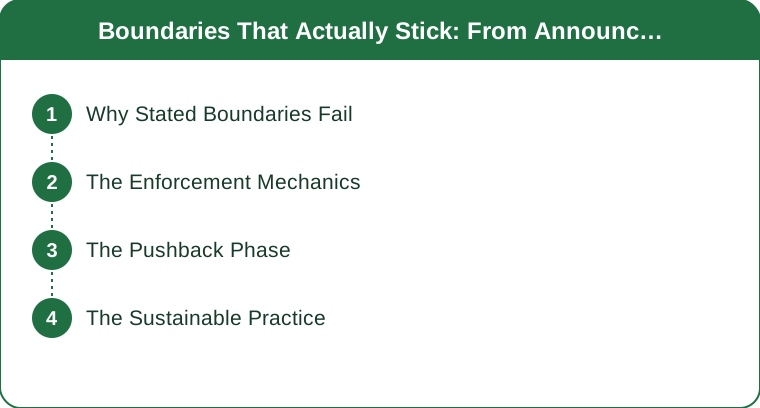
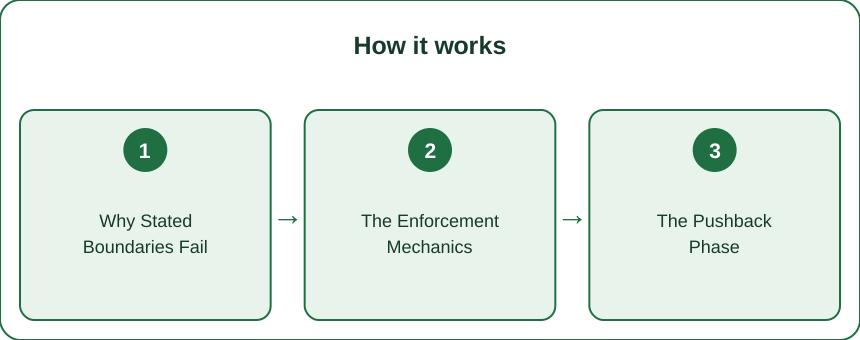
Why Stated Boundaries Fail
The failure anatomy: boundaries are behaviors, not announcements (the world learns your real rules from what you DO — answering the 8pm message twice repeals the 7pm rule regardless of what was declared), the intermittent-reinforcement trap (responding ‘just this once’ teaches senders that persistence works — the slot-machine psychology of the sometimes-available person), and the guilt mechanics (boundary-holders feel the discomfort FIRST and the benefits later — the gap between is where most boundaries die; expecting the discomfort is half of surviving it).
The Enforcement Mechanics
The systems that hold when willpower wavers: structural beats behavioral (the notification schedule, the auto-reply, the app timer — a boundary enforced by settings survives tired evenings that promises don’t; the phone’s own tools are boundary infrastructure), the substitute-response rule (the boundary needs a replacement behavior — ‘I don’t answer at night’ pairs with ‘I flag it for 9am’; boundaries with service windows get respected faster than walls), and the consistency-over-size principle (the small boundary held always beats the grand one held sometimes — the world recalibrates to reliable signals only).

The Pushback Phase
Surviving the extinction burst: pushback is evidence it’s working (the system testing a new rule pushes HARDER briefly before accepting it — the behavioral-psychology ‘extinction burst’ arrives on schedule; expect the surge, hold through it, and the new normal lands), the broken-record technique (the same calm sentence, repeated without new justifications — every added excuse is a negotiation door; ‘I’m not available then, I’ll get to it at nine’ works on the fourth repetition), and the escalation triage (most pushback is habit, not malice — but the boundary chronically overridden by the same person is data about the relationship, worth its own conversation).
The Sustainable Practice
The long game: start with one (the single kept boundary builds the identity and the evidence — the boundary muscle trains like any other; the everything-at-once boundary overhaul collapses like every crash program), the review rhythm (boundaries serve seasons — the rule that saved last year’s burnout may need renegotiating, and updating a boundary deliberately is strength, not slippage), the guilt-reframe (the discomfort of holding a boundary is the cost; the resentment of not holding it is the bigger invoice — you’re choosing between discomforts, and one of them compounds), and the quiet payoff (people trust reliable-you more than available-you — the boundary that survived its pushback phase becomes invisible infrastructure everyone plans around). Announced is nothing; enforced is everything.
Behavior teaches the rule, settings beat willpower, pushback means it’s working, one boundary first. Boundaries stick at enforcement — hold the small one calmly and the world recalibrates.
Keep Reading
This article is for general informational purposes only and is not medical advice. Always consult a qualified health professional for guidance specific to you.