The Burnout That Shows Up as Not Wanting to See Anyone
Quick Answer: Withdrawing from people is a recognised component of burnout - the depersonalisation dimension in the standard model - and it commonly appears before exhaustion is severe enough to be obvious. The distinguishing feature is that the relief of cancelling is followed by no actual recovery, and that the withdrawal is indiscriminate rather than selective. Genuine introversion is choosing solitude and being restored by it. This is avoiding contact and not feeling better afterward.
You cancelled on a friend for the third time, felt an immediate wash of relief, and then spent the evening not really doing anything at all.
That sequence - the relief, followed by nothing - is the part worth paying attention to.

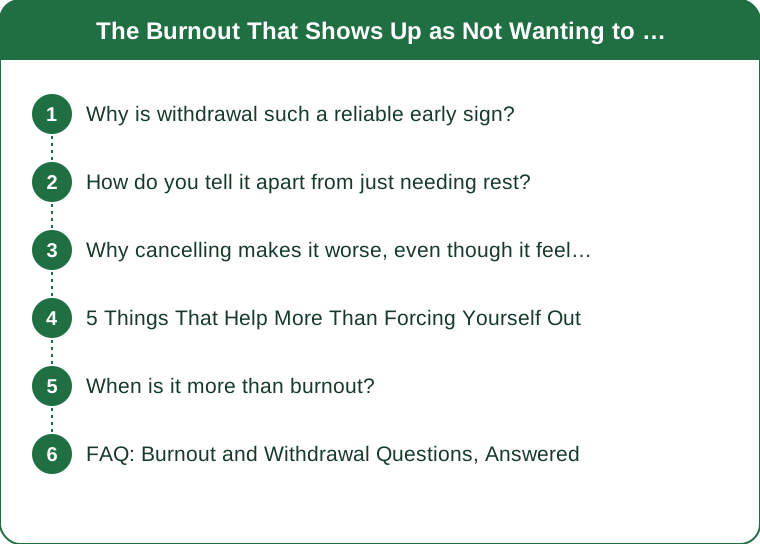
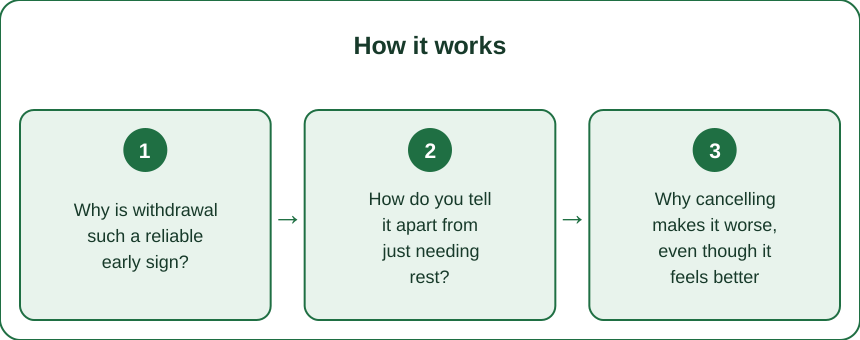
Why is withdrawal such a reliable early sign?
Because social contact is the most demanding discretionary thing in most weeks, so it is the first thing dropped.
The well-established model of burnout has three dimensions: exhaustion, cynicism or depersonalisation, and reduced sense of accomplishment. The middle one is the withdrawal component - a distancing from other people that starts as protection and becomes a habit.
The mechanism is straightforward. Work and obligations are not optional, so when capacity drops, the cuts happen in the discretionary column. Social plans are the largest item in that column, and they are the easiest to cancel without immediate consequence.
What makes it hard to spot is that each individual cancellation is entirely reasonable. You were tired. It was a long week. You will see them next month. There is no single decision that looks like a symptom.
It is only visible in aggregate - which is why the useful question is not why did I cancel tonight, but how many things have I cancelled in the last two months.
How do you tell it apart from just needing rest?
Four distinctions, and they are fairly reliable.
Does the relief last? Legitimate rest produces recovery - you feel better afterward. Withdrawal from burnout produces relief at the moment of cancelling and then an evening that restores nothing. If cancelling repeatedly leads to feeling no better, the cancelling is not the solution it appears to be.
Is it selective or indiscriminate? Ordinary tiredness is selective - you decline the draining event and keep the one you want. Burnout withdrawal is indiscriminate. The people you genuinely enjoy get cancelled at the same rate as the obligations.
Has it spread beyond social plans? Not replying to messages, avoiding phone calls, dreading a casual conversation at the school gate, letting a friendship go quiet - that spread is the signal that this is capacity rather than preference.
How long has it run? A few weeks of hibernating after a hard period is normal and healthy. Two or three months of steady withdrawal is a pattern rather than a phase.
If you are recognising several of these, that is worth taking seriously rather than continuing to interpret it as having become more of a homebody.
Why cancelling makes it worse, even though it feels better
This is the uncomfortable part, and it is why the pattern is self-sustaining.
Social connection is one of the more reliably protective factors against burnout. Time with people who are not connected to the source of your depletion restores something that solitary rest does not - the research on social support as a buffer against occupational stress is fairly consistent.
So the withdrawal removes one of the recovery mechanisms at precisely the point it is most needed. The energy saved by cancelling is real but small; the recovery lost is larger and less visible.
There is a second-order effect too. Friendships that go quiet for months become harder to re-enter, and the effort required to reconnect grows the longer it goes on. That rising cost makes the next cancellation more likely, which is how a few weeks becomes a year.
None of this means the answer is to force yourself to a full social calendar. It means the withdrawal deserves to be treated as a symptom rather than as an accurate reading of what you need.

5 Things That Help More Than Forcing Yourself Out
1. Shrink the unit, do not cancel it. A coffee for forty minutes instead of dinner for three hours. The problem is usually duration and unpredictability rather than the person, and a small defined commitment is far more achievable than a large open-ended one.
2. Choose low-demand formats. A walk beats a dinner. Side-by-side activity requires far less performance than sitting across a table making conversation, and it is much easier when depleted.
3. Pick the person, not the event. One person you genuinely find easy, rather than a group. Group settings require sustained attention and social monitoring; one-to-one does not.
4. Reply to the message even if you decline the plan. The relationship maintenance is most of the value, and it costs a fraction of the energy. Silence is what does the real damage over months.
5. Protect the recovery time properly. Withdrawal often produces evenings spent scrolling, which restores nothing and consumes the whole evening. If you are going to stay in, actually rest - which for most people means not a screen.
The underlying principle: reduce the size of contact rather than eliminating it, because eliminating it removes the thing that was helping.
When is it more than burnout?
Withdrawal is a shared feature of burnout and depression, and the distinction matters because the responses differ.
Some useful markers, though none of them are diagnostic:
Burnout tends to be context-specific. It is closely tied to a particular source of depletion - usually work or caregiving - and people often notice that a genuine break, a holiday, or a change of role produces real improvement.
Depression tends to be pervasive. It affects enjoyment across all contexts, including things unrelated to the source of stress, and it typically does not lift with a week away.
Sleep and appetite patterns change more markedly in depression, as does self-worth in a broad rather than work-specific way.
The honest position is that they overlap substantially and the boundary is not always clear, including to professionals. What matters practically is this: if the withdrawal has lasted more than a few weeks, if you are losing interest in things you used to enjoy across the board, if your sleep or appetite have changed significantly, or if you have any thoughts of harming yourself, that warrants a conversation with a doctor rather than a self-management strategy.
Asking for help early tends to shorten all of this considerably. This is general information, not medical advice.
FAQ: Burnout and Withdrawal Questions, Answered
What if I have always been introverted?
The relevant question is not how much solitude you want but whether it restores you. Introversion means being genuinely recharged by time alone. If the alone time is no longer recharging anything, the introversion is not what is driving this.
How do I explain months of silence to a friend?
Most people need considerably less explanation than you expect. A short honest message - I have been running on empty and went quiet on everyone, not just you - resolves the vast majority of it. The dread of the conversation is almost always larger than the conversation.
Is it worth pushing through and going anyway?
Sometimes, in the reduced form described above. Forcing yourself to a full evening you dread usually confirms that socialising is depleting, which reinforces the pattern. A forty-minute coffee that goes well does the opposite.
How long does this take to reverse?
The social side often improves faster than the underlying burnout, which is encouraging - a few genuinely good short interactions can shift things within weeks. The exhaustion itself typically takes months and usually requires changing something about the source, not just resting harder.
TL;DR:
- Social withdrawal is a recognised burnout dimension, and it often appears before exhaustion is obvious.
- The tell is that relief from cancelling is followed by no recovery - the evening restores nothing.
- Indiscriminate withdrawal, including from people you enjoy, separates it from ordinary tiredness.
- Cancelling removes a protective factor at exactly the point it is most needed.
- Shrink the unit rather than cancelling: a forty-minute walk with one person beats a three-hour dinner.
- Reply even when you decline. Silence over months is what does the real damage.
Each individual cancellation is reasonable. It is only the pattern over two months that tells you anything, which is why it is worth actually counting. This is general information, not medical advice.
Keep Reading
This article is for general informational purposes only and is not medical advice. Always consult a qualified health professional for guidance specific to you.