The First Good Week Back Is Exactly When People Overcommit
Quick Answer: After a break, energy returns before capacity does - you feel restored while your actual tolerance for sustained demand is still rebuilding. The predictable result is that people say yes to several things during the good week and hit a wall three or four weeks later, frequently concluding the rest did not work. The protective move is a commitment freeze: make no new lasting commitments for the first two to three weeks back, regardless of how good you feel.
You came back feeling genuinely better, so you agreed to the project, the committee, and the thing on Thursdays. It is now four weeks later and you feel worse than you did in July.

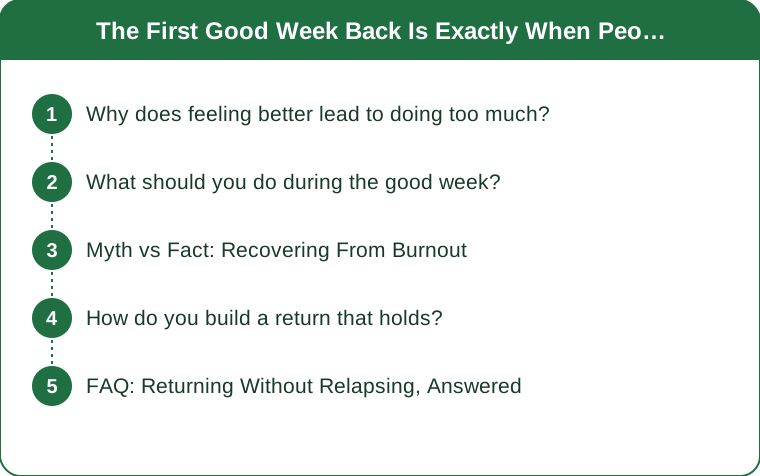
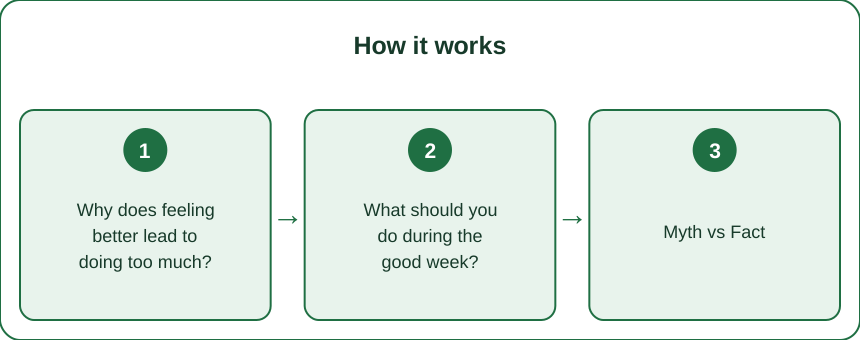
Why does feeling better lead to doing too much?
Short-term energy recovers faster than sustained capacity. A holiday can restore how you feel in a week, while the underlying depletion that developed over months takes considerably longer to resolve. The feeling arrives first and it is genuinely misleading.
Rest effects from time off are well documented as fading quickly. Research on holiday recovery consistently finds that improvements in wellbeing tend to dissipate within a few weeks of returning, particularly when workload returns to what it was.
Decisions get made at your best moment and lived at your worst. You agree to something on the Tuesday of a good week; you deliver it during a bad month. Almost nobody accounts for that gap.
Autumn multiplies it structurally. September is when organizations start projects, when school and community commitments restart, and when people set personal goals - so the requests arrive in a cluster precisely during the window when you feel most able to accept them.
And there is a compensating instinct. People who felt they underperformed while depleted frequently over-commit on return as a way of making up for it, which is the exact opposite of what a recovering system needs.
The result is a predictable timeline. Feel good, commit, feel fine for two or three weeks, then decline sharply around week four to six - and conclude that the rest was pointless when in fact it was spent.
What should you do during the good week?
Impose a commitment freeze for two to three weeks. No new recurring obligations, no new projects, no new voluntary roles. The freeze is not a judgement about any specific request - it is a blanket rule, which is what makes it possible to hold.
Use a delay script rather than a refusal. I am not taking anything new on until October, ask me then. It is honest, it is not a no, and it moves the decision to a point where you have better information.
Notice which requests arrive first. The things people ask you for in your first week back are usually the things you are known for absorbing, which is diagnostic information about how your capacity has been used historically.
Write down what you removed while you were away. Most people quietly drop things during a break and feel better partly because of it. Those items are candidates for permanent removal rather than automatic reinstatement.
Reinstate deliberately and one at a time. Adding commitments back individually, with a week between each, tells you which ones actually cost you - information you never get when everything returns at once.
And protect the recovery behaviours before the productive ones. Sleep, movement, and time off screens are what rebuilt the good feeling, and they are always the first things to be traded when the calendar fills.

Myth vs Fact: Recovering From Burnout
Myth: A good holiday fixes burnout. Fact: time off relieves acute exhaustion, but recovery effects tend to fade within weeks if the conditions that caused it are unchanged. Rest is necessary and generally not sufficient.
Myth: If you feel fine, you are recovered. Fact: feeling fine is a state, not a capacity measure. The relevant question is how you feel after four consecutive demanding weeks, and that cannot be answered during week one.
Myth: Recovery is linear. Fact: it commonly plateaus, and a stall around the six-week mark is a frequently reported pattern rather than a sign of failure.
Myth: Taking on less means falling behind. Fact: the alternative - overcommitting and stalling in October - produces far less output across a quarter than a sustainable level does.
Myth: You will notice yourself sliding back. Fact: the early signs are subtle and easily explained away as ordinary busyness. This is why a pre-set rule works better than an intention to monitor how you feel.
How do you build a return that holds?
Set a review date before you need one. Put a date four to six weeks out in the calendar to assess how the return is going. Reviewing on a schedule beats reviewing when you are already struggling.
Define your warning signs in advance and write them down. Sunday dread returning, waking at four, dropping the exercise, cancelling social plans, feeling detached at work. Named in advance, they are far easier to notice.
Keep one recovery behaviour genuinely non-negotiable. Not five - one. The one you would miss most. Protecting a single thing absolutely is more durable than protecting five things approximately.
Address the causes, not just the load. If the depletion came from a specific role, relationship, or workload structure, then the sustainable version requires changing that - and a conversation with a manager is frequently the actual intervention.
Expect the autumn cluster and plan for it. The next several weeks will bring more requests than any other period of the year, and knowing that in advance turns each one from a decision into an application of an existing rule.
And take persistent symptoms seriously. Burnout overlaps with depression and anxiety, and exhaustion can have medical causes - thyroid problems, anaemia, sleep disorders, and perimenopause among them. If you are not improving, or you have low mood, hopelessness, or thoughts of harming yourself, speak to a doctor. This is general information, not medical advice.
FAQ: Returning Without Relapsing, Answered
Why do I feel worse a month after a holiday than during it?
Recovery effects from time off tend to fade within weeks when workload returns unchanged - and most people add commitments during the good week, which brings the wall forward rather than pushing it back.
How long should I wait before taking on new commitments?
Two to three weeks as a blanket rule, then reinstate one at a time with a week between each. That spacing is what tells you which commitments actually cost you.
How do I say no during my first week back?
Use a delay rather than a refusal: not taking anything new on until October, ask me then. It is honest, it holds, and it moves the decision to a point where you know more.
When should I see a doctor about burnout?
If you are not improving despite reducing load, or if you have persistent low mood, hopelessness, or thoughts of harming yourself. Exhaustion can also have medical causes worth ruling out. This is general information, not medical advice.
TL;DR:
- Energy returns before capacity does, so the good week after a break is the most dangerous week for decisions.
- Impose a two-to-three week commitment freeze as a blanket rule, and use a delay script rather than a refusal.
- Note what you dropped while you were away - much of it is a candidate for permanent removal.
- Reinstate commitments one at a time with a week between each, and protect one recovery behaviour absolutely.
- Write your warning signs down in advance and set a review date four to six weeks out.
September brings more requests than any other month, and they land exactly when you feel most able to accept them. Decide the rule before they arrive.
Keep Reading
This article is for general informational purposes only and is not medical advice. Always consult a qualified health professional for guidance specific to you.