When Your Burnout Recovery Turned Into Another To-Do List
Quick Answer: If your recovery plan has six components, tracked, with a daily completion standard, you have rebuilt the structure that exhausted you and pointed it at yourself. Recovery from burnout requires reducing total demand, and a demanding recovery routine adds demand. Cut it to one thing you would do anyway, remove all tracking, and accept that this will feel like giving up. It is not.
It started reasonably. A walk, better sleep, less caffeine.
Now there are nine things, three of them have apps, and this morning you felt genuinely bad about missing the journaling.

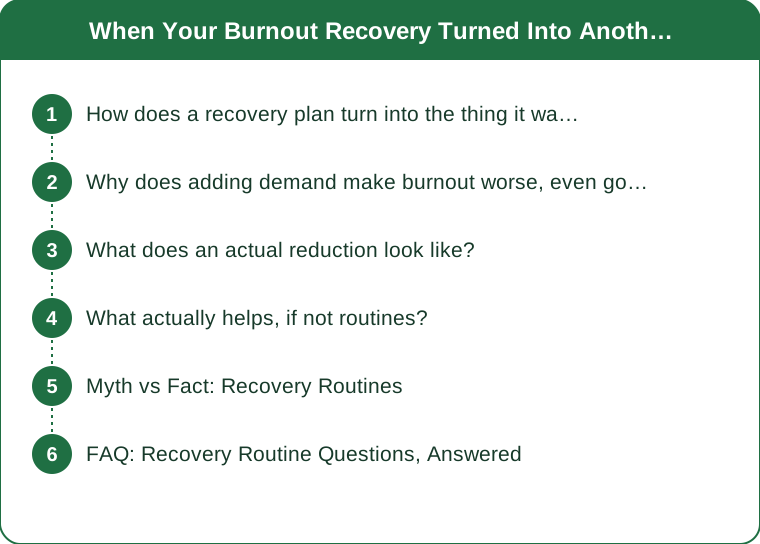
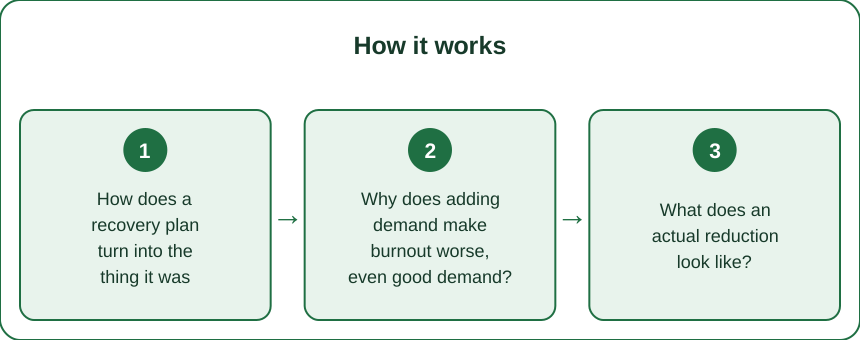
How does a recovery plan turn into the thing it was fixing?
Through the exact set of traits that produced the burnout in the first place.
Most people who burn out are conscientious, high-standard, and responsive to structure. Those traits do not switch off when the burnout arrives. So when you decide to recover, you apply the only method you have ever used successfully: you make it a project, you set standards, and you measure whether you are meeting them.
And now recovery has the same shape as the job:
- A defined set of daily obligations.
- A standard you can fall short of.
- A tracking mechanism that reports your shortfall back to you.
- A vague, receding definition of done.
The critical difference from actual work is that there is no external deadline and no one else’s expectation, which sounds easier and is often harder — the standard is entirely internal, which means there is nothing to negotiate with.
The tell that this has happened: you feel guilty about a recovery activity. Guilt about not journaling is a completely coherent signal that journaling has become an obligation, and obligations are the thing in surplus. The moment recovery generates guilt, it has switched sides.
Why does adding demand make burnout worse, even good demand?
Because burnout is fundamentally a demand-versus-resource imbalance sustained over time, and the recovery mechanism is reducing demand or increasing resources. A recovery routine reliably does the first thing to yourself while claiming to do the second.
Consider what a six-component morning routine actually costs before 9am:
- Decisions about what order, whether there is time, what to skip.
- Time, usually taken from sleep, which is the single most protective resource you have.
- Self-monitoring, which is cognitively expensive and is exactly the loop burnout has already inflamed.
- A judgement at the end about whether you did it properly.
Even if every individual component is beneficial in isolation, the aggregate is a structured, monitored, evaluated block of obligations at the most depleted point in a burnout recovery.
There is a second mechanism, and it is the more damaging one. A recovery plan you are failing at generates evidence that you cannot even manage recovery. For someone already low on self-efficacy, that is genuinely harmful — it converts a neutral situation into a source of additional self-criticism, and self-criticism is a well-documented maintainer of burnout and low mood.
If your recovery plan is producing negative self-judgement, it is not neutral. It is actively working against you.
What does an actual reduction look like?
One thing. No tracking. No standard. That is genuinely it, and the difficulty is entirely in accepting how little it is.
Choose one thing, and choose it by this test: would you do it anyway, on a bad day, if nobody knew? A walk you enjoy. Sitting outside with a coffee. Ten minutes of music. Reading something with no purpose.
What disqualifies something:
- You do it because it is good for you. That is an obligation wearing a costume.
- It has an app.
- You can fail at it. If there is a version of the day where you did it wrong, it is a task.
- It requires preparation.
Then remove everything else, and specifically:
- Delete the tracking. Streaks, habit apps, the tick chart. The measurement is a substantial part of the load and removing it changes how the whole thing feels within days.
- Stop the optimisation reading. Podcasts and articles about recovery are a demand — they generate more things you are not doing.
- Drop the schedule. Not at 6:30am. Whenever.
What to expect: it will feel like giving up. Deeply, uncomfortably. That feeling is the conscientiousness that produced the burnout, protesting the reduction. It usually eases within two or three weeks, and if it does not, that is worth talking to a professional about — persistent guilt at rest can point to something beyond burnout.

What actually helps, if not routines?
The things that reduce demand rather than add activity. They are less satisfying because you cannot do them and feel productive.
Reduce actual load. This is the whole game and everything else is secondary. Fewer commitments, fewer responsibilities, genuinely saying no. It is harder and less appealing than adding a morning routine, which is precisely why people add morning routines instead.
Protect sleep by protecting the schedule, not by optimising it. A consistent, adequate sleep window matters enormously. A sleep protocol with six steps does not. If your sleep routine has more than two components, it is a project.
Keep movement, and keep it unstructured. Movement genuinely helps burnout and low mood. A training programme with progression targets is a different thing. Walk, or do something you like, without a plan.
Maintain low-effort social contact. Withdrawal is common in burnout and it worsens it. This does not mean organising things — it means saying yes occasionally, and being around people without an agenda.
Deal with what is causing it. Burnout with an ongoing cause does not resolve through recovery activities. If the cause is workload, a manager, or a role, the recovery is bounded by that until something changes. This is uncomfortable and it is the most important item here.
And professional support. Burnout overlaps substantially with depression and anxiety, and telling them apart is genuinely difficult from the inside. If you are struggling — persistent low mood, no enjoyment, hopelessness, or any thoughts of harming yourself — please speak to a doctor or a mental health professional. This is general information, not medical advice.
Myth vs Fact: Recovery Routines
Myth: If the routine is not working, you need to be more consistent with it. Fact: Consistency is the standard advice for building habits when you have spare capacity. In burnout you do not have spare capacity, and pushing consistency converts a helpful activity into a demand. The correct response to a failing recovery routine is usually to make it smaller, not to try harder.
Myth: Doing nothing is not recovery. Fact: Genuine unstructured rest, where nothing is required and nothing is being optimised, is a large part of what recovery is. It feels unproductive because it is, and that is the point. People who recover well generally do considerably less than people who do not.
Myth: You should feel better within a few weeks. Fact: Burnout recovery is commonly measured in months, not weeks, and it is not linear. Expecting a quick return produces a sense of failure at week four, which is roughly when many people abandon the reduction and add more structure. This is the point where most recoveries go wrong, and knowing it is coming helps more than anything else on this page.
Myth: A good routine would fix it if you found the right one. Fact: There is no routine that fixes an ongoing excess of demand. If the load has not changed, no morning practice will resolve it. The search for the right routine is often, functionally, avoidance of the harder conversation about the load.
Myth: Cutting back means you will lose all your good habits. Fact: Habits you actually value come back when you have capacity. Habits that only existed because you were forcing them were not habits. Very few people who reduce during burnout look back and wish they had journaled more.
FAQ: Recovery Routine Questions, Answered
How do I know if my routine is helping or hurting?
One question: does missing it produce guilt? If yes, it is a demand. Helpful activities feel like a relief to do and neutral to skip. That distinction is reliable and it takes ten seconds to apply.
Is it normal to feel worse after cutting back?
For a couple of weeks, often yes. Structure provides a sense of control, and removing it is uncomfortable even when the structure was costing you. If it persists beyond a few weeks or deepens significantly, speak to a doctor.
What if my job requires me to be highly structured?
Then the case for unstructured personal time is stronger, not weaker. The problem is not structure itself — it is total structured load. If your day is heavily scheduled by necessity, the recovery has to come from the unscheduled part.
When should I get professional help rather than managing this myself?
If it has persisted for months without improvement, if it is affecting your ability to function at work or at home, if you cannot tell whether it is burnout or depression, or if you have any thoughts of harming yourself. Speak to a doctor. Burnout and depression share many features and the treatments differ, which is a good reason to get an actual assessment rather than working it out alone. This is general information, not medical advice.
TL;DR:
- A recovery plan with components, standards, and tracking is the structure that burned you out, pointed at yourself.
- The tell: guilt about missing a recovery activity. Helpful things feel like relief to do and neutral to skip.
- Cut to one thing you would do anyway on a bad day. Delete the tracking, the schedule, and the optimisation reading.
- What actually helps is reducing load, protecting a consistent sleep window, unstructured movement, and low-effort contact.
- Burnout with an ongoing cause does not resolve through recovery activities. The cause has to change.
- Recovery takes months and is not linear. Week four is where most people add structure back — expect it.
It will feel like giving up. It is not. If you are struggling, please speak to a doctor. This is general information, not medical advice.
Keep Reading
This article is for general informational purposes only and is not medical advice. Always consult a qualified health professional for guidance specific to you.