The 'No' Scripts: Polite Refusals for the Chronically Overcommitted
Quick Answer: You can say no without over-explaining by using a short set of ready-made scripts — citing capacity, buying time before answering, offering a smaller “partial yes,” or calmly repeating your answer when someone pushes back. Practicing these on low-stakes requests makes them available when the stakes are higher.
Someone pings you with “quick favor” energy, and before your brain even weighs the request, your mouth is already saying yes. Ten minutes later you’re staring at your calendar wondering how you agreed to co-chair something you don’t even remember being asked about. If that sounds familiar, the problem usually isn’t willpower — it’s that you’ve never rehearsed what “no” actually sounds like out loud.

Why is saying no so much harder than it sounds?
In the moment, saying yes feels easier because it avoids an awkward pause — but that short-term relief is exactly what leads to chronic overcommitment. Most people trace their burnout back to the same root cause: not one dramatic event, but a long series of small yeses that quietly added up. Having a script ready removes the improvisation, which is usually where the panic-yes happens.
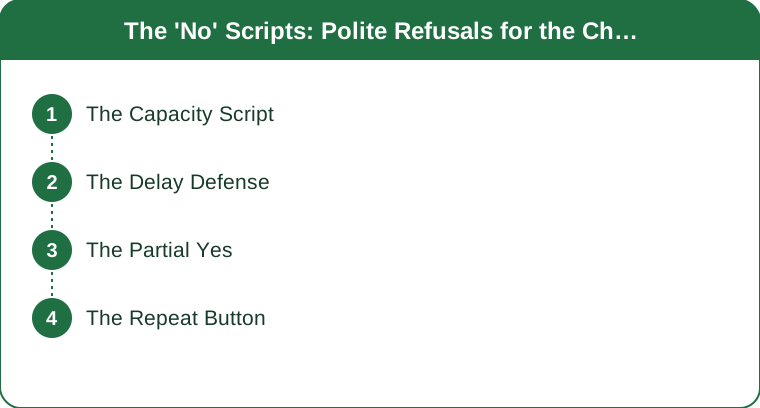
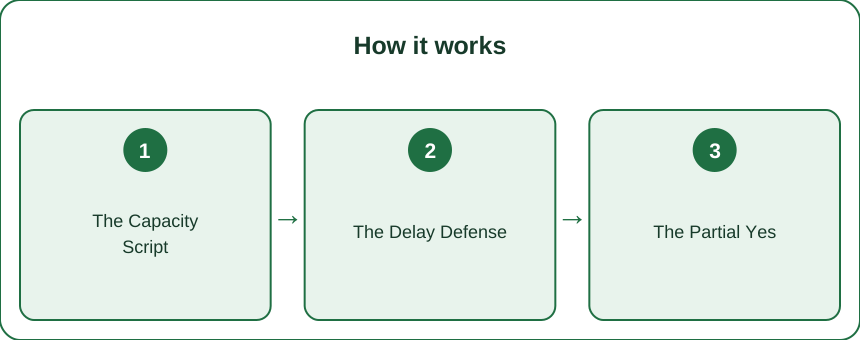
What’s a simple script for declining based on capacity?
Try: “I’m at capacity right now and can’t take this on without dropping something important.” This works because it’s honest and hard to argue with — nobody can fact-check your bandwidth the way they could poke holes in a made-up excuse. A few reasons the capacity script holds up so well:
- It doesn’t require justifying why you’re at capacity, just stating that you are
- It signals respect for the task (you’re not dismissing it, you’re protecting your ability to do things well)
- It’s reusable — the same line works for a meeting invite, a favor, or a new project
How do you buy yourself time before committing to something?
Say: “Let me check my week and get back to you tomorrow.” This single sentence converts an ambush yes into a considered answer, and 24 hours is usually enough time for the requester’s urgency to cool off. A surprising number of “urgent” asks turn out to be much more flexible once you’re not answering in the hallway with someone standing over your desk.

Is there a middle ground between yes and no?
Yes — the partial yes. Something like: “I can’t run the event, but I can review the plan for an hour.” This gives what you genuinely have to offer while protecting the rest of your time. A partial yes, freely given, tends to land better than a full yes that shows up resentful and half-finished a week later. A few situations where it works well:
- Committee or event asks where you can contribute a narrow slice of expertise
- Favors where a smaller version (a quick review vs. full involvement) still helps
- Team requests where showing up briefly matters more than showing up fully
What do you do when someone pushes back on your no?
Repeat the same sentence again, just a little warmer: “I really can’t this time.” Resist the urge to invent a new reason — a new reason gives the other person something fresh to negotiate against, while repeating the original one gives them nothing to push on. This “kind broken record” approach isn’t rude; it’s just consistent, and consistency is what actually ends a boundary standoff.
What Nobody Tells You About Saying No
Nobody tells you that the first few times feel worse, not better — your brain treats disappointing someone as a real threat, so a little discomfort is normal, not a sign you’re doing it wrong. Nobody tells you that most people forget your “no” within a day, even though it feels enormous to you in the moment. And nobody tells you that practicing on low-stakes asks (a bake sale, an optional meeting) is what makes the higher-stakes ones — a bigger project, a boundary with a manager — actually manageable when they come up.
A quick caveat: these scripts help with everyday overcommitment, but if you’re constantly exhausted, dreading work, or feel like you can’t say no even when you try, that can be a sign of burnout that’s bigger than a communication habit. It’s worth talking to a doctor, therapist, or counselor if that persistent, heavy feeling doesn’t ease up — boundaries help, but they’re not a substitute for professional support when things feel truly unmanageable.
Mini FAQ
What if my job genuinely requires me to say yes to my manager?
The capacity script still works here — it’s less about refusing outright and more about surfacing trade-offs, like “I can take this on if something else moves.” It turns a flat no into a negotiation about priorities.
How do I say no without sounding cold or rude?
Warmth comes from tone and brevity, not from over-explaining. A short, calm “I can’t take this on right now” said kindly reads as more respectful than a long, apologetic excuse that invites debate.
Will people stop asking me for favors if I say no too often?
Not usually — people generally respect a consistent, honest no more than a resentful yes that shows up late or half-done. If anything, a track record of honest answers makes your yeses more trustworthy.
TL;DR
- Overcommitment usually comes from many small yeses, not one big decision.
- The capacity script (“I’m at capacity right now”) is honest and hard to argue with.
- The delay script (“Let me check and get back to you”) converts panic-yeses into real decisions.
- The partial yes offers what you can without overcommitting to the whole ask.
- When pushed, repeat your answer calmly instead of inventing new reasons.
- Practice on low-stakes requests so the scripts are ready when it matters more.
Keep Reading
This article is for general informational purposes only and is not medical advice. Always consult a qualified health professional for guidance specific to you.