Why the Weekend Never Fixes Burnout - and What Actually Restores You
Quick Answer: Weekends fail against burnout because recovery is not the absence of work - it is the presence of specific experiences: psychological detachment from the job, genuine relaxation, mastery of something that is not your job, and a sense of control over your time. A Saturday of errands plus a Sunday of inbox-adjacent dread contains none of the four. The rebuild: a Friday shutdown ritual that closes the loops, one protected half-day anchor block, something you are getting better at that has nothing to do with work, and a Sunday evening designed against the scaries. And if no weekend ever helps, that is data about the job, not about your resting skills.
The math everyone runs - I rest two days out of seven, so why am I still exhausted - assumes rest is what happens when work stops. Months of burnout research say otherwise: work stopping is just the venue. What happens in it decides everything.

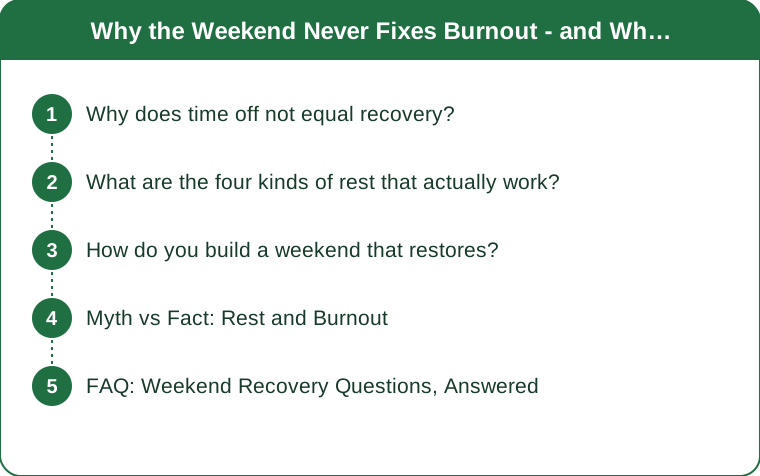
Why does time off not equal recovery?
Because your job attends your weekend without a badge. The recovery research tradition - much of it built on psychologist Sabine Sonnentag’s work - keeps landing on the same finding: the benefit of off-hours depends less on their number than on whether psychological detachment happens, meaning the work is mentally gone, not just physically paused. Rumination - replaying the meeting, pre-living Monday, half-drafting the reply in your head - keeps the stress physiology running at idle all weekend. Two days of idle is not repair; it is lower-intensity work.
Because errands are a second job. The Saturday of groceries, laundry, returns, and life-admin is genuinely necessary and genuinely not restorative - obligation with a different logo. Many weekends contain zero hours that belong to you by choice, and choice, it turns out, is one of the active ingredients.
Because sleep debt repays partially and slowly. Sleeping until ten on Saturday takes the edge off a week of six-hour nights but does not clear the ledger - and the Sunday sleep-in pushes bedtime later, manufacturing Monday’s tiredness fresh.
And because chronic burnout is not a two-day-sized problem. Burnout - the exhaustion, cynicism, and reduced-efficacy triad the WHO frames as an occupational phenomenon - builds over months of demand outrunning recovery. Weekends can slow the accumulation and genuinely help at the edges. What they cannot do is refund the balance while the same week that created it waits on the other side.
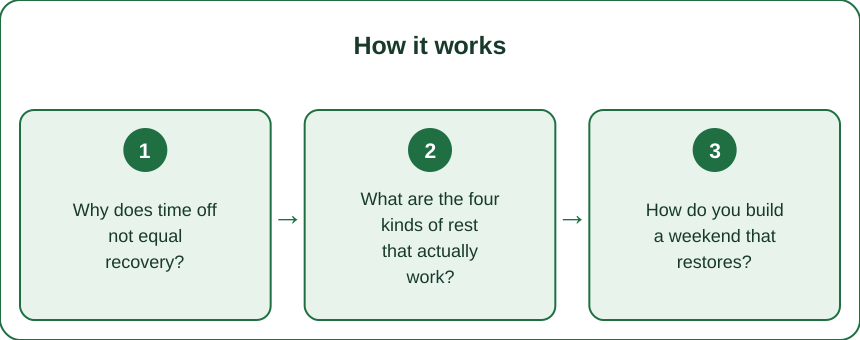
What are the four kinds of rest that actually work?
Recovery research keeps returning to four experiences - a useful audit for any weekend that felt like nothing.
1. Detachment: the work is mentally gone. Not thinking about the job is the heavyweight of the four - and it is a condition you engineer, not a virtue you summon. Notifications off or the app parked, a physical departure (trailhead, pool, market), and absorbing activity that leaves no bandwidth for rumination. Detachment is why a hike restores more than a couch scroll with the same duration: the couch leaves the channel open.
2. Relaxation: the body actually downshifts. Low-demand, low-effort calm - reading, a long bath, slow cooking, lying in the yard doing verifiably nothing. The nervous system needs some hours at genuinely low arousal, and doomscrolling does not qualify; it is sedentary stimulation.
3. Mastery: getting better at something that is not your job. The counterintuitive one - effortful activities like a language app streak, a climbing grade, a sourdough experiment, a 5k plan restore rather than drain, because they rebuild exactly what burnout erodes: competence and progress that belong to you. Tired-but-satisfied is a different chemical than depleted.
4. Control: hours that are yours by choice. Autonomy over some block of the weekend - what, when, with whom - counters the specific helplessness of a schedule owned by other people.
The weekend that fixes nothing usually scores zero for four. A good one does not need perfection - two solid experiences reliably beat two days of neither.

How do you build a weekend that restores?
Friday: close the loops so they do not run all weekend. The shutdown ritual is ten minutes: write Monday’s top three, note the open items and who is waiting, then an explicit end - laptop shut, a walk around the block, gym clothes on. Rumination feeds on unclosed loops; the list is how you set them down without dropping them. The Zeigarnik itch of unfinished tasks quiets remarkably when the tasks have a written home.
Saturday: one anchor block, protected like a flight. A half-day - even three hours - reserved for one chosen thing: the long hike, the market-and-cook morning, the pool, the pottery class, the ride. Ideally it hits detachment plus mastery or relaxation at once, happens away from home’s chore gravity, and phones stay in pockets. Errands get corralled into a bounded window around it - contained, not sprawling. One anchor per weekend is the difference between a weekend that happened to you and one you had.
Sunday: run it low-decision, and rig the evening. Slow morning, easy movement, social or solo per your battery. Then take the scaries seriously as design material: a 20-minute prep block in the afternoon - calendar glance, clothes out, lunch plan - collapses the ambient dread that otherwise fogs the whole evening; the inbox stays shut, because the 9pm peek restarts the workweek early and refunds nothing; and the evening gets an actual plan - the good dinner, the show, the porch - because dread expands to fill unstructured time.
And late August is a friendly co-conspirator: the anchor block practically schedules itself while the mornings are golden and the water is warm.
Myth vs Fact: Rest and Burnout
Myth: A vacation will reset you. Fact: Vacation effects are real and evaporate within weeks when the working conditions are unchanged - the research on post-vacation fade is depressingly consistent. Trips help; only different weeks change the trajectory.
Myth: Real rest means doing nothing. Fact: Pure idleness often leaves burnout untouched because it skips mastery and control entirely - and hands rumination an empty stage. Restorative weekends usually contain effort that happens to be chosen.
Myth: Needing rest this badly means you are weak. Fact: Burnout is framed by the WHO as an occupational phenomenon - a workplace-conditions story, not a character one. Recovering harder cannot fully compensate for a job that demands faster than any human refills.
Myth: Catching up on sleep Sunday fixes the week. Fact: It partially repays the debt while shifting your clock late, which manufactures Monday exhaustion on schedule. Boring-consistent sleep beats heroic weekend oversleeping.
Myth: If weekends do not help, you are resting wrong. Fact: Sometimes - the four-experience audit is worth running honestly first. But weekends that never help despite genuine detachment and anchors are a message about workload, boundaries, or the role itself, and persistent exhaustion with low mood or hopelessness deserves a professional conversation, not another productivity trick. This is general information, not medical advice.
FAQ: Weekend Recovery Questions, Answered
Why am I still exhausted after a full weekend off?
Usually because the weekend contained no detachment - the job attended mentally - and no chosen, absorbing activity. Errands plus scrolling plus Sunday dread is two more days of low-grade load. Audit against the four experiences: detachment, relaxation, mastery, control.
What is the best thing to do on weekends for burnout?
One protected half-day anchor doing something chosen and absorbing - away from home, phone parked - plus a Friday shutdown list and a rigged Sunday evening. Two of the four recovery experiences per weekend is a realistic, effective bar.
How do I stop thinking about work on my days off?
Engineer it rather than willing it: close Friday’s loops on paper, remove the app-shaped doors work walks through, and fill hours with activities absorbing enough to occupy the channel - company, movement, and hands-busy hobbies all outperform willpower.
When is it more than a bad stretch?
When months of weekends and even time away change nothing, when cynicism and dread are the baseline, or when exhaustion comes with persistent low mood, sleep collapse, or hopelessness - that pattern warrants talking to a professional and looking hard at the job itself, not optimizing another Saturday.
TL;DR:
- Rest is not the absence of work: recovery needs detachment, relaxation, mastery, and control - most failed weekends score zero for four.
- Close Friday’s loops on paper, protect one half-day anchor block, corral errands, and rig Sunday evening against the scaries.
- Vacations fade within weeks when the week itself is unchanged; chosen effort restores more than pure idleness.
- Weekends that never help despite real rest are data about the job - and persistent exhaustion with low mood belongs in a professional conversation.
The weekend was never big enough to refund months of overdraft, but it can stop the bleeding and hand you back two days that feel like yours. Build the anchor, shut the loops, guard the Sunday evening - and let what the weekend still cannot fix point you at what actually needs changing.
Keep Reading
This article is for general informational purposes only and is not medical advice. Always consult a qualified health professional for guidance specific to you.