Why September Burnout Hits People Who Took a Good Summer Break
Quick Answer: A break removes the load without changing what created it, so returning restores the same conditions to a nervous system that has stopped being numb to them. The contrast makes the workload legible in a way it was not before. Add the September schedule surge and shrinking daylight and you get a sharp dip in the first three weeks back. It is a signal about the conditions, not evidence that the rest failed.
This is one of the most common and least discussed patterns in the working year, and it is routinely misread as a personal failing.

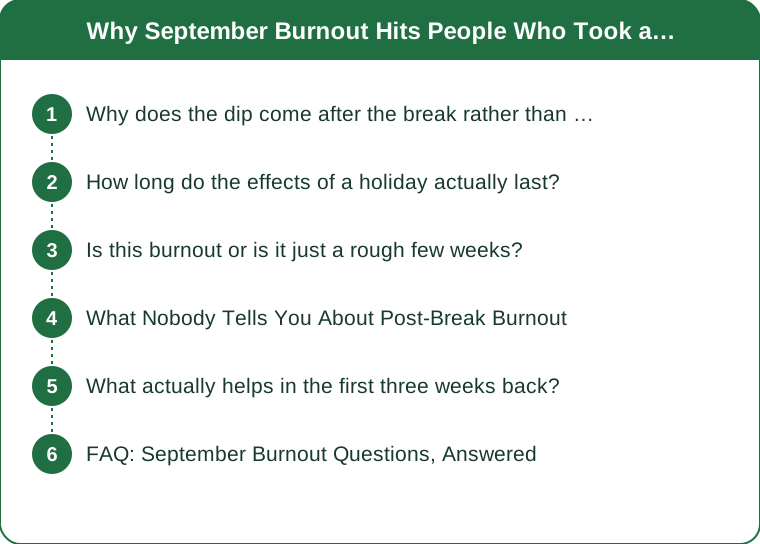
Why does the dip come after the break rather than before it?
Three mechanisms, and they compound.
Contrast makes the load visible. Chronic stress produces a degree of adaptation - you stop noticing the level you are operating at because it has become the baseline. A genuine break resets that baseline. When you return, you are perceiving the same workload without the numbing, which is why it feels heavier than it did before you left. The load did not increase. Your sensitivity to it was restored.
Nothing structural changed. A break is a pause in exposure, not a change in conditions. The workload, the understaffing, the unclear expectations, the difficult relationship - all of it is exactly as you left it, and often with two weeks of accumulation on top. The research on burnout consistently points to the conditions rather than the individual’s coping capacity as the driver. A holiday is a coping intervention applied to a conditions problem.
The return itself is a spike. The backlog, the catching up, the meetings that were deferred - the first fortnight back is measurably more demanding than an ordinary fortnight, at the exact point you were expecting relief.
And the September specifics: everyone else returns at the same time, so demand across the whole system surges. School routines restart. Daylight is shrinking fast, which is degrading sleep quality and mood for reasons that have nothing to do with work. Four things arriving together in one three-week window.
How long do the effects of a holiday actually last?
Shorter than people expect, and the research is fairly consistent on this.
Studies on vacation and recovery generally find that the improvements in wellbeing and exhaustion fade quickly on return - often within a few weeks, sometimes faster. The effect is real during and immediately after the break, and it does not persist.
What appears to make the effect last slightly longer:
- Genuinely disconnecting from work during the break rather than checking in
- Longer breaks, though with diminishing returns - the benefit does not scale linearly with duration
- A gradual return rather than straight into a full week
- Sustaining some element of the break’s activities afterward
What does not extend it: how expensive or impressive the holiday was, and how much you did during it.
The implication that matters. If a two-week break produces a few weeks of relief, then holidays cannot be your primary recovery mechanism. They are a top-up, not a treatment. A working pattern that requires an annual holiday to be survivable is not sustainable, and the annual holiday is the thing obscuring that.
This is not an argument against holidays. The relief is real and worth having, and a system that only functions with them is telling you something about the system. Both things are true, and the second one is the one that gets ignored every September.
Is this burnout or is it just a rough few weeks?
There is a meaningful distinction, and it determines what to do.
Burnout, as it is generally characterised, has three components:
- Exhaustion - depleted energy that rest does not resolve
- Cynicism or detachment - mental distance from the work, negativity about it
- Reduced sense of efficacy - feeling ineffective, that nothing you do matters
It is classified as an occupational phenomenon rather than a medical condition, and specifically as something arising from chronic workplace stress that has not been successfully managed. The framing matters: it locates the cause in the conditions rather than in the person.
A rough few weeks looks like: tiredness that improves with a weekend, still caring about the outcome, still finding some of it engaging, and a clear sense that it is temporary.
The distinguishing questions:
- Does a weekend help at all, even briefly?
- Do you still care whether the work is done well?
- Is there anything about it you still find interesting?
- Can you identify a specific end point?
Mostly no to those means this is not a rough patch. Mostly yes and it probably is.
The overlap that needs naming: burnout and depression share substantial symptoms - exhaustion, low mood, loss of interest, difficulty concentrating. The rough distinction is that burnout is typically work-specific while depression pervades everything, but the distinction is not clean, and people frequently self-diagnose burnout when something else is going on. If the low mood extends into things unrelated to work, or you have lost interest in things you normally enjoy, that is worth taking to a doctor. This is general information, not medical advice.

What Nobody Tells You About Post-Break Burnout
The break did not fail. It worked, and then you returned to the thing. People conclude that rest does not work for them, which is the wrong lesson and leads to giving up on rest entirely.
Feeling worse afterward can be a good diagnostic sign. It means the numbing lifted enough for you to perceive the conditions accurately. That perception is uncomfortable and it is more useful than the adapted state, because it is the thing that prompts a change.
Most burnout interventions are aimed at the individual and the evidence favours the organisational ones. Resilience training, mindfulness apps, and wellness programmes place the responsibility on the person experiencing a systemic problem. They are not useless and they are treating a symptom. Interventions that change workload, autonomy, or role clarity consistently outperform them.
Autonomy matters more than hours. A frequently observed finding is that control over how and when you work protects against burnout substantially, sometimes more than the total volume does. Two jobs with identical hours can differ enormously on this, which is why hours alone predict burnout poorly.
The people who burn out are frequently the most engaged, not the least. It is not a resilience deficit. Caring a lot about work with insufficient control or resources is close to the standard profile.
Recovery from established burnout takes months, not weeks. This is the part that is hardest to hear. The expectation that a long weekend will fix it produces a repeating cycle of brief relief and renewed disappointment, and the cycle itself becomes demoralising.
What actually helps in the first three weeks back?
Five things, split between what you can do immediately and what needs a longer conversation.
Immediate, and worth doing this week:
Protect the morning light. Ten to twenty minutes outside within an hour of waking. The daylight is shrinking fast right now and the circadian effect is real - this addresses the seasonal component of the dip, which is a genuine and separate contributor that people attribute entirely to work.
Rebuild one boundary, not five. Pick the single most consequential one - no email after a fixed hour, a protected lunch break, one day without meetings - and hold it. Attempting a full reset in week one back fails, and the failure adds to the sense of ineffectiveness.
Schedule recovery rather than hoping for it. Micro-breaks through the day have better evidence than people assume - short, deliberate detachment repeated regularly appears to matter more than a single large block at the weekend. Two ten-minute walks beat an intention to relax later.
Longer, and this is where the actual change is:
Name the specific conditions. Not I am burnt out, but the workload assumes two people, or I have no say over the priorities, or the deadlines move weekly. Specific conditions can be negotiated; a general state cannot. This is the difference between a conversation that changes something and one that does not.
Have the conversation with someone who can change something. A manager, HR, or if the situation warrants it, a doctor. If the honest answer is that nothing will change, that is important information about what to do next rather than a reason to endure another year and another September.
One realistic note. Some of what causes burnout is genuinely outside your control, and advice that implies otherwise is part of the problem. What is within your control is naming it accurately, protecting the recovery that is available, and making an informed decision about whether the conditions are going to change. Sometimes the answer to burnout is a different job, and that is a legitimate conclusion rather than a failure.
If you are experiencing persistent low mood, hopelessness, or thoughts of harming yourself, contact a doctor or a crisis line - that is beyond the scope of anything here and it is treatable.
FAQ: September Burnout Questions, Answered
Why do I feel worse after a holiday than before it?
The break restores your sensitivity to a workload you had adapted to, and you return to the same conditions plus a backlog. The contrast is what makes it feel heavier.
How long do holiday benefits last?
Research generally finds the improvement fades within a few weeks of returning, sometimes faster. Holidays are a top-up rather than a solution.
Is burnout the same as depression?
They share substantial symptoms and are not the same thing. Burnout is characterised as work-related; depression typically pervades everything. If low mood extends beyond work, see a doctor.
How long does recovery take?
From established burnout, months rather than weeks, and it generally requires the conditions to change rather than just more rest.
What if my workplace will not change anything?
That is real information rather than a dead end. It tells you the individual strategies are managing a situation rather than resolving it, which is a legitimate basis for a decision about what comes next.
TL;DR:
- A break removes the load without changing the conditions, so returning restores it to a nervous system that stopped being numb
- Holiday benefits fade within a few weeks - they are a top-up, not a treatment
- September compounds it: backlog, system-wide demand surge, and fast-shrinking daylight
- Burnout is exhaustion plus cynicism plus reduced efficacy, and it is a conditions problem, not a resilience one
- Protect morning light, rebuild one boundary, and name the specific conditions rather than the general state
The rest worked. You went back to the thing that caused it. That is a statement about the thing, not about you.
Keep Reading
This article is for general informational purposes only and is not medical advice. Always consult a qualified health professional for guidance specific to you.