Tired vs Depleted: Why Rest Fixes One and Not the Other
Quick Answer: Tired is a sleep and energy deficit - it responds to rest, and a good night or a quiet weekend produces a noticeable improvement. Depleted is a resource deficit in motivation, emotional capacity, and cognitive control, and it does not respond to rest alone because rest replaces sleep, not meaning or autonomy or recovery from sustained demand. The practical test: if a genuinely restful weekend leaves you feeling roughly the same on Monday, the problem is not sleep. Depletion responds to reducing sustained demand, restoring some control over your time, and reconnecting with things that produce rather than consume energy.
You slept nine hours on Saturday. You did almost nothing on Sunday. And Monday morning felt exactly like the Monday before. That is not a rest failure. It is a diagnosis.

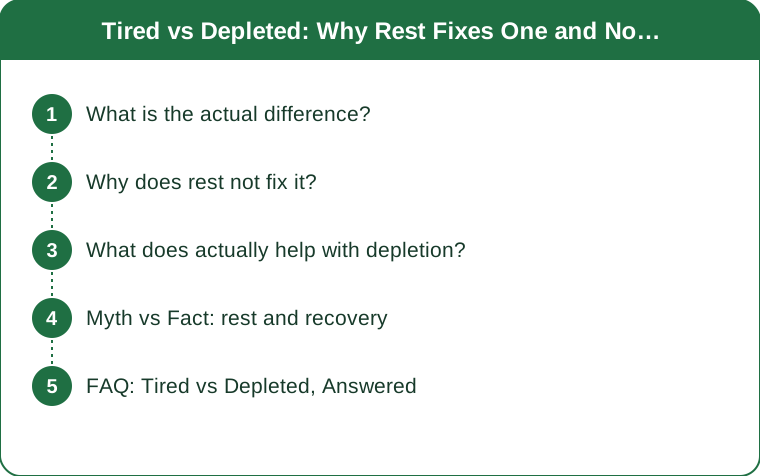
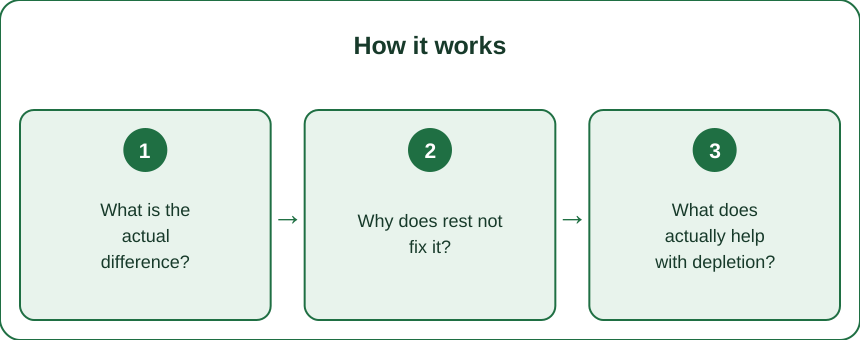
What is the actual difference?
Tired is straightforward. It comes from insufficient sleep, physical exertion, or a long day, and it has an obvious signature: you feel sleepy, your body wants to stop, and sleep resolves it. The relationship between input and output is clean - sleep more, feel better.
Depleted is a different system. The exhaustion is not sleepiness; people often describe being wired and unable to switch off despite feeling completely drained. Key markers:
- Sleep happens and does not restore
- Small decisions feel disproportionately effortful
- Emotional reactions are flatter or more volatile than usual
- Things you used to enjoy generate no pull
- The prospect of Monday produces something closer to dread than reluctance
- Concentration is patchy, and reading or focused work takes several attempts
The classic descriptions of burnout centre on exhaustion, cynicism or detachment, and reduced sense of effectiveness. Depletion is the middle ground - past ordinary tiredness, not necessarily at clinical burnout, and it is the stage where intervention is most effective and most often missed.
Why does rest not fix it?
Because rest replenishes one resource and depletion has drained several.
Sleep restores physiological energy. It does not restore autonomy, meaning, competence, or social connection - and sustained deficits in those are what produce the depleted state.
Three specific reasons a weekend does not work:
- The demand does not stop. If Monday returns you to the same load, a weekend is a pause rather than a recovery. Recovery requires the demand to change, not just to be interrupted.
- Rest without recovery activity is empty. Lying on the sofa with your phone is an absence of demand, not a presence of restoration. Research on recovery consistently distinguishes between psychological detachment, relaxation, mastery experiences, and control - and passive rest supplies only some of these.
- Anticipation eats the rest. Sunday afternoon is often already occupied by Monday. The weekend was 48 hours long on paper and perhaps 30 in practice.
The thing that makes it worse: when rest does not work, the natural conclusion is that you need more rest. So people take a longer holiday, feel briefly better, return, and are back within a week - which is one of the most commonly reported experiences among people in this state, and it reinforces the belief that nothing helps.

What does actually help with depletion?
The evidence points at a different set of levers than the ones people reach for.
1. Reduce sustained demand, even slightly. This is the hardest and the most effective. Not a break from the load - a genuine reduction in it. One fewer commitment, one boundary held, one thing handed over. A 10 percent reduction in ongoing demand outperforms a week away, because it changes the equation rather than pausing it.
2. Restore some control. Perceived control over your own time is one of the strongest protective factors against burnout. Even small recoveries help disproportionately - one protected hour, one meeting you decline, one decision you get to make unilaterally.
3. Do something with mastery in it. Counterintuitively, effortful activities that produce competence - learning something, making something, training for something - are restorative in a way passive rest is not. They generate resources rather than merely not consuming them.
4. Detach properly rather than partially. Half-checking messages all weekend prevents psychological detachment entirely. Two hours with the phone in another room does more than a full day of ambient availability.
5. Protect sleep anyway. Sleep will not fix depletion, but insufficient sleep makes everything else harder. It is necessary and not sufficient.
6. Reconnect with why. Depletion is strongly associated with a loss of felt meaning in what you spend your days on. Even brief, deliberate contact with the part of the work that mattered has a measurable effect.
Myth vs Fact: rest and recovery
Myth: If you are exhausted, you need more sleep.
Fact: If you have slept well and still feel exhausted, more sleep will not help and chasing it can produce sleep anxiety on top. The signature of depletion is that sleep happens and does not restore.
Myth: A holiday will reset you.
Fact: Vacation effects on wellbeing are typically short-lived, often fading within two to four weeks of return. A holiday is a pause. It works well as a top-up on a sustainable load and does very little against an unsustainable one.
Myth: Doing nothing is the most restorative option.
Fact: Passive rest helps physical tiredness. For depletion, activities with mastery and control in them consistently outperform pure inactivity - which is why people sometimes come back from an active weekend feeling better than from a slow one.
Myth: Depletion means you are not resilient enough.
Fact: Sustained excessive demand depletes people regardless of resilience, and the most conscientious people are frequently the most affected because they absorb load rather than deflecting it. Treating it as a personal failing delays the structural change that would actually resolve it.
Myth: You will notice when it becomes serious.
Fact: The characteristic feature is gradual adjustment - each week’s baseline becomes normal. People routinely realise how depleted they were only after they are out of it, which is why external feedback from people close to you is worth taking seriously.
FAQ: Tired vs Depleted, Answered
How do I test which one I have?
Take one genuinely restful period - a full weekend with real detachment, adequate sleep, and no work contact. If Monday feels meaningfully better, it was tiredness. If Monday feels the same, it is depletion, and more of the same rest will not change the answer.
Can you be both at once?
Usually, yes - depletion tends to produce poor sleep, which adds ordinary tiredness on top. Address the sleep because it makes everything else more manageable, but do not expect it to resolve the underlying state.
How long does recovery from depletion take?
Longer than people expect, and it tracks whether the demand changed. Reports of recovery taking months rather than weeks are common, particularly when the underlying load stayed the same. The variable that matters most is not time off; it is whether anything about the ongoing situation is different.
When is this a clinical matter?
If low mood, loss of interest, hopelessness, or thoughts of self-harm are present, or if the exhaustion is accompanied by physical symptoms without an obvious explanation, that is a conversation with a doctor rather than a scheduling problem. Depression and depletion overlap substantially in presentation and differ in treatment, and thyroid problems, anaemia, and sleep disorders all produce a similar picture.
This is general information, not medical advice.
TL;DR:
- Tired is a sleep deficit and responds to rest. Depleted is a deficit in autonomy, meaning, and emotional capacity - and rest does not touch it.
- The test: one genuinely restful weekend. Same on Monday means it is not sleep.
- Rest fails because the demand does not change, passive rest is not recovery, and Sunday is often already spent on Monday.
- What works: reduce ongoing demand slightly, restore some control, do something with mastery in it, detach fully rather than partially.
- A holiday is a pause, not a reset - the effect typically fades within weeks of returning.
If you have been resting and it is not working, the honest read is that you have been treating the wrong deficit. That is not a failure of rest. It is information about what actually needs to change.
Keep Reading
This article is for general informational purposes only and is not medical advice. Always consult a qualified health professional for guidance specific to you.