The September Surge: Why Recovery Unravels Every Fall
Quick Answer: Recovery from burnout usually unravels in September for a structural reason: the boundaries that made summer restorative were circumstantial rather than deliberate. When the circumstances change, the boundaries vanish with them. The fix is to identify which two or three summer conditions actually did the work, and rebuild those specific ones as explicit commitments before the schedule fills.
The pattern shows up every year. Someone spends the summer genuinely recovering - sleeping better, working less, feeling like themselves again - and by the end of September is back where they started, often faster than they got there the first time.

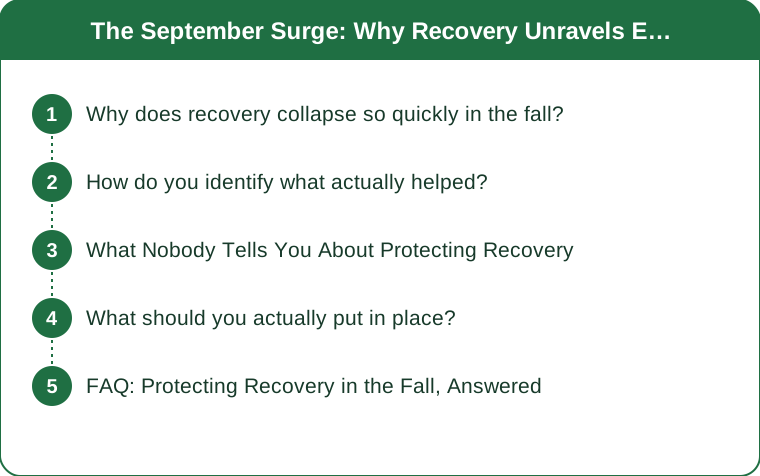
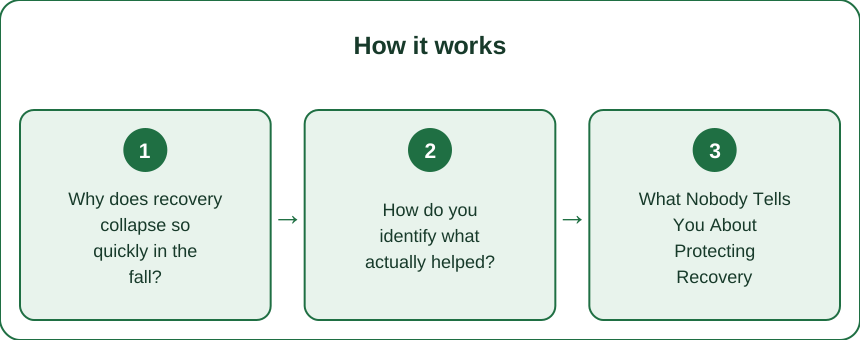
Why does recovery collapse so quickly in the fall?
Because most summer recovery is a side effect of an environment rather than a set of habits.
Over the summer, meetings thin out, colleagues are away, deadlines shift, and social obligations relax. Recovery happens because the demand went down, not because anything was built. When demand returns, there is no structure holding the space open.
The second factor is compensation load. Everything deferred over the summer lands in the same three weeks, so the return is not to normal demand but to well above it. That temporary spike is when the old patterns - skipping breaks, working late, saying yes reflexively - come back, and patterns re-established under pressure tend to stay.
The third is that recovery raises capacity, which is normally good and here is a trap. You feel better, so you take on more, and the extra capacity is spent immediately rather than kept as margin. This is the most common way people re-enter the cycle, and it is nearly invisible while it is happening.
None of this means recovery was fake. It means it was environmental, and environments change.
How do you identify what actually helped?
Be specific, because vague answers produce vague protections.
Look back at the summer and ask what was different in kind, not just in amount. Common answers: fewer meetings, no evening email, more time outdoors, more sleep, fewer social commitments, a longer morning, more autonomy over the schedule.
Then narrow it. Which two or three of those, if you lost them, would you notice within a week? That is the shortlist worth protecting, and it is usually shorter than people expect.
For most people the list looks something like: a genuine stop time in the evening, protected sleep, and one unscheduled block a week. Those three carry most of the load.
The reason for narrowing ruthlessly is that a long list of protections is unenforceable, and an unenforceable protection is worse than none - it produces the feeling of failing at recovery on top of the original problem.
Write the two or three down. A protection that only exists as an intention does not survive a busy week.

What Nobody Tells You About Protecting Recovery
Recovery capacity is spent by default. Unless a boundary is explicit, feeling better simply converts into doing more. The extra capacity has to be deliberately kept as margin or it is gone within weeks.
The first three weeks decide the year. Patterns established during the return period tend to persist. The version of you that answers email at 10pm in the second week of September is setting a norm for everyone around you, including yourself.
Boundaries are easier to set before the demand arrives. Declining a recurring commitment in August is a scheduling note. Declining it in October is a conflict. The same decision costs far less if it is made early.
Other people calibrate to your last observed behavior. If you were unreachable in August and instantly responsive in September, the September version becomes the expectation. Adjusting gradually is more sustainable than a hard switch in either direction.
Rest that is scheduled gets taken; rest that is left over does not. Unscheduled time is the first thing consumed by a full calendar. Blocking it makes it real.
A relapse is not a reset to zero. Recognizing the pattern in week three is a completely different position from not recognizing it until March, and it is worth noticing that improvement rather than treating any slip as total failure.
What should you actually put in place?
Three concrete structures, put in place before the schedule fills rather than after.
A stop time, written down and told to someone. Not a target - a specific time when work ends. Telling one colleague or one person at home makes it real in a way a private intention is not.
One protected block per week, in the calendar, defended like a meeting. Ninety minutes is enough. It is the first thing to get eaten if it is not booked, and the last thing you will regret keeping.
A weekly check on two markers. Choose two things that reliably signal you are drifting - for many people, sleep and whether they are still doing the one activity they enjoy. Check them at the same time each week. Two markers checked consistently beat a detailed self-assessment nobody does.
And one decision made in advance: what you will drop if the load exceeds capacity. Deciding this while calm is enormously easier than deciding it under pressure, and the reason people carry too much is usually that nothing was ever designated as droppable.
This is general information, not medical advice. Burnout that includes persistent low mood, hopelessness, or significant impairment in daily functioning is worth discussing with a doctor or a mental health professional - it overlaps with depression and anxiety, and it responds to proper support.
FAQ: Protecting Recovery in the Fall, Answered
How do I know if I am relapsing or just having a busy month?
Busy months are bounded and you can see the end. Relapse feels open-ended, and the tell is usually the recovery activities disappearing first - the walk, the reading, the thing you enjoy. That disappearance is the earliest reliable signal.
What if my workload genuinely does not allow boundaries?
Then the boundary conversation is a workload conversation, and it is worth having explicitly rather than absorbing the gap personally. If the honest answer is that the role requires more than one person can sustain, that is information about the role rather than about you.
Is it worth trying to keep everything that helped over the summer?
No, and trying usually fails. Two or three specific protections that survive a busy week are worth more than a comprehensive plan that collapses in the second week of September.
TL;DR:
- Summer recovery is usually environmental, so it vanishes when the environment changes.
- The compensation surge in the first three weeks is when old patterns return and become the new norm.
- Identify the two or three summer conditions that actually mattered and make them explicit commitments.
- Set a written stop time, block one protected period a week, and decide in advance what gets dropped.
The fall unraveling is predictable, which makes it preventable. Pick two protections this week, write them down, and let the version of you in October inherit a decision rather than a crisis.
Keep Reading
This article is for general informational purposes only and is not medical advice. Always consult a qualified health professional for guidance specific to you.