The September Restart That Quietly Causes Burnout
Quick Answer: The autumn restart produces a burst of motivation that leads people to commit to more than their ordinary week can hold - a new routine, a new project, a new class, and the return of everything that paused over summer. The commitments are made in a high-energy week and paid for over the following three months, which is why late November is one of the most common points for burnout to surface. The fix is to add one thing at a time and to subtract before you add.
Almost nobody plans a September that they could sustain in November.

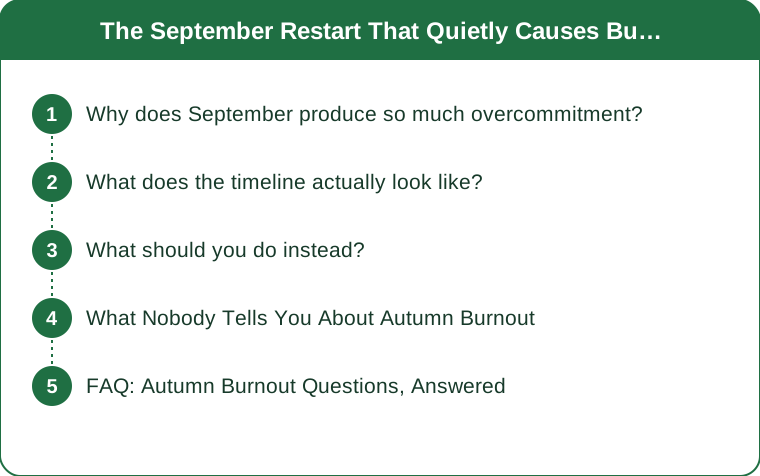
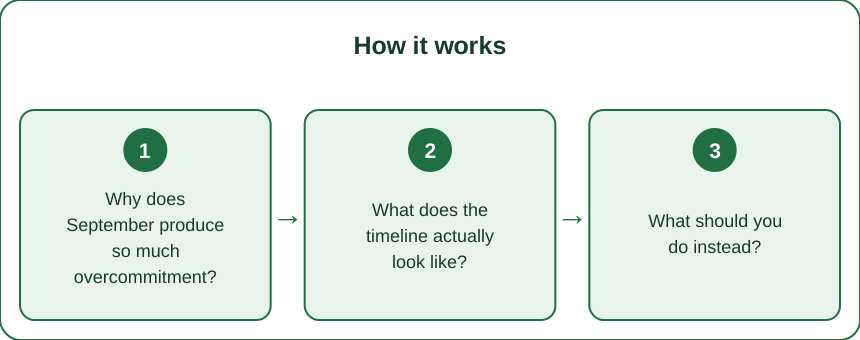
Why does September produce so much overcommitment?
A genuine psychological effect meeting a genuine seasonal reset, at exactly the moment your calendar refills.
The fresh start effect is the well-documented tendency to feel more motivated to pursue goals at temporal landmarks - the start of a year, a month, a week, or a season. September functions as a second January for most people, particularly anyone with school-year rhythms in their life.
Three things arrive at once:
- Genuine energy, often after a summer break, which makes everything feel more possible than it will in six weeks
- A structural reset - terms start, work resumes properly, routines re-form
- A flood of opportunities - new classes, new projects, new commitments, all launching at the same time
The problem is that the decision and the cost are separated in time. You commit in a week when you have energy and space, and you pay for it in weeks when you have neither. The version of you making the commitment is not the version who has to execute it.
And there is a compounding factor: everyone around you is doing the same thing, which raises the perceived normal level of commitment. A September calendar looks reasonable in September and unmanageable in November, when the days are short, illness is circulating, and the end-of-year workload arrives.
What does the timeline actually look like?
Predictable enough to plan around, which is the useful part.
Weeks 1 to 3 - the honeymoon. High energy, everything new, the routine feels achievable. This is when the commitments are made, and everything is genuinely fine.
Weeks 4 to 6 - the first strain. The novelty fades. The new routine now competes with the ordinary demands that have re-formed around it. This is usually the first point where something gets dropped, and what gets dropped is almost always the thing that was for you rather than for someone else.
Weeks 7 to 10 - accumulation. Sleep debt builds, daylight reduces sharply, and the first illnesses circulate. The commitments made in week one are now being fulfilled on considerably less capacity than they were designed for.
Weeks 11 to 14 - the wall. Late November into December. Short days, end-of-year deadlines, and social obligations arrive on top of everything else. This is the most common point for burnout symptoms to become undeniable - exhaustion that sleep does not fix, cynicism about work, and reduced effectiveness.
Knowing this shape is genuinely useful, because it means the intervention point is week one to three, when everything feels fine. By week eleven the options are much worse - dropping things mid-commitment, or continuing on empty.
If you are experiencing persistent exhaustion, low mood, or symptoms that are affecting your daily functioning, speak to a clinician. Burnout overlaps with several conditions that deserve proper assessment. This is general information, not medical advice.

What should you do instead?
Subtract before you add, stage the additions, and plan for November rather than for September.
Rule 1: subtract before you add. For anything new, name what is coming out of the week to make room. If nothing can come out, the week is full, and adding to it means something will be dropped later without your choosing which.
Rule 2: add one thing at a time, two weeks apart. A new class, then two weeks, then a new project. You find out what a commitment actually costs after about two weeks, not on day one, and staging means you learn that before making the next decision.
Rule 3: design for your worst week, not your best. The question is not whether you can do this in September. The question is whether you can do it in the third week of November, in the dark, with a cold. If the answer is no, scale it now.
Rule 4: put a review date in the calendar. Mid-October, deliberately, to assess what is working. A planned review removes the sense that dropping something is failure - it is a scheduled decision.
Rule 5: protect one unstructured block a week. Not an activity, not a class - genuinely unstructured. It is the first thing to be colonised by commitments and the thing whose absence is felt most sharply by November.
A practical reframe: the goal is not the most ambitious autumn. It is arriving at December still doing the things you started in September, which is a much less common outcome than it sounds.
What Nobody Tells You About Autumn Burnout
Burnout is not the same as tiredness, and the distinction matters. It is generally described as involving exhaustion, mental distance or cynicism about your work, and reduced effectiveness. Exhaustion alone is tiredness. The cynicism component is the distinguishing feature, and it is the one people tend not to report because it feels like a character flaw rather than a symptom.
A holiday does not fix it. Rest helps exhaustion temporarily, but if the conditions producing the burnout are unchanged, the effect fades within days of returning. This is one of the most reliably reported experiences and it surprises people who expected a week off to reset things.
Reduced daylight makes everything harder and is not a character issue. Shorter days affect mood, energy, and sleep for a substantial number of people. Getting outside during daylight hours, particularly in the morning, is one of the more effective and least discussed interventions for the autumn period - and it becomes harder exactly when it matters most.
The things that protect you are usually the first things cut. Exercise, seeing friends, hobbies, and unstructured time all look optional when the calendar tightens. They are the buffer, and removing the buffer is what turns a demanding autumn into a bad one.
Saying yes in September is a decision about November. The commitment feels small when made and is executed under entirely different conditions. A useful habit: before agreeing to anything, imagine doing it on the darkest, busiest week of the year.
And the people who seem to be managing more than you frequently are not. Autumn overcommitment is close to universal, and everybody is comparing their own difficult reality against everybody else’s presented version.
FAQ: Autumn Burnout Questions, Answered
How do I tell burnout from ordinary tiredness?
Tiredness improves with rest. Burnout typically involves exhaustion that rest does not resolve, growing cynicism or detachment about work, and a sense of reduced effectiveness. If it persists, speak to a clinician.
Is it too late if I have already overcommitted?
No. Reviewing in October and dropping one or two things is far easier than reaching November on empty. A planned withdrawal is much less costly than an unplanned collapse.
How do I drop something I have already agreed to?
Early and directly. Most people are far more understanding about a commitment withdrawn in week four than one abandoned in week twelve, and the earlier notice is genuinely more useful to them.
Does exercise help or add to the load?
Moderate regular exercise generally helps with stress, mood, and sleep. An ambitious new training programme added to an already full autumn is a different thing and can add to the load.
What if the demands are not optional?
Then the protective factors matter more, not less - sleep, daylight, movement, and connection. And if the demands are genuinely unsustainable over months, that is a conversation worth having with a manager or a clinician rather than absorbing alone.
TL;DR:
- The fresh-start effect makes September the most overcommitted month of the year
- The commitments are made in a high-energy week and paid for in the darkest one
- Subtract before you add, and stage new commitments two weeks apart
- Design the week for late November, not for September
- Protect one unstructured block - it is the buffer, and it is the first thing cut
The autumn restart is genuinely useful energy, and the point is not to waste it. It is to spend it on one or two things that will still be running in December, rather than on five that will all have quietly collapsed by then.
Keep Reading
This article is for general informational purposes only and is not medical advice. Always consult a qualified health professional for guidance specific to you.