The Sunday Scaries: Why the Dread Hits and How to Actually Defuse It
Quick Answer: The Sunday Scaries are anticipatory anxiety — your brain rehearsing Monday’s stress before it’s even happened. You can take the edge off in the moment with a 10-minute Monday prep and a protected wind-down routine, and if the dread is intense every single week, treat it as a signal to look at your job and workload, not just a mood to push through.
It’s 4pm on Sunday. The laundry’s half-folded, there’s still daylight outside, and somehow your stomach already knows Monday is coming. That heavy, sinking feeling has a name — the Sunday Scaries — and it’s a lot more common than the silence around it suggests.
Why does Sunday night dread hit so hard?

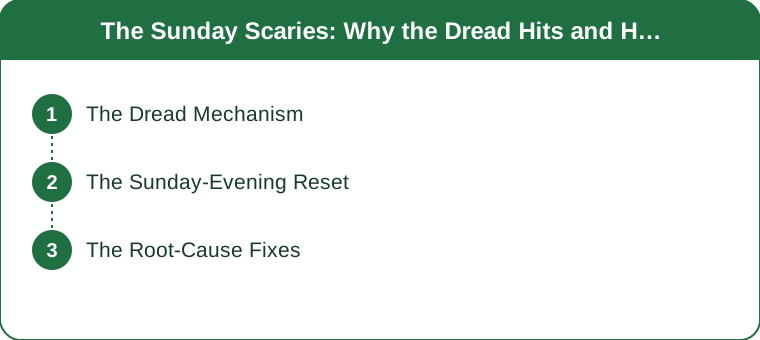
The main culprit is anticipatory anxiety — your brain doesn’t just react to stress, it pre-lives it. Somewhere around late Sunday afternoon, it starts running a highlight reel of everything that might go wrong Monday, and that dread is a forecast, not a fact. Your nervous system is basically borrowing trouble from a day that hasn’t happened yet.
A few other things pile on:
- Freedom-loss grief. The weekend’s unstructured time is ending, and some part of you genuinely mourns that. Resisting a transition is normal, not dramatic.
- The unfinished-business amplifier. An un-prepped week, a looming deadline, an unanswered email — these open loops love to replay themselves right when you’re trying to relax.
- The burnout signal. If the dread is intense, physical, and shows up every single week without fail, it’s worth reading as data. That’s not just “Sunday being Sunday” — it might be a sign the job or the workload itself needs a look.
Here’s the honest scope: the everyday version of the Scaries responds well to a bit of routine. The severe, can’t-get-out-of-bed, depression-adjacent version is a different animal, and that one deserves a real conversation with a professional — more on that below.
What can you actually do when the dread hits?

You don’t need a huge intervention — you need to interrupt the spiral. Try this 10-minute Monday prep: glance at your calendar, jot your top three tasks, and sort tomorrow’s outfit and lunch. Dread feeds on vagueness, and vagueness starves fast once you’ve got a plan on paper. It sounds almost too simple to work, which is exactly why most people skip it — and exactly why it’s the one that sticks.
A few more moves that genuinely help:
- Protect Sunday evening like it’s sacred. A bath, a book, a favorite show, an early wind-down — claim the evening as rest, not pre-work anguish.
- Do a worry dump. Write your anxieties down in a messy list. It sounds too simple to matter, but getting them out of your head and onto paper closes the mental tabs your brain keeps refreshing.
- Get outside for 20-30 minutes. A walk, some fresh air, a little sunlight — movement is a legitimate anxiety-lowering tool, not just a cliché.
- Set a hard boundary on Sunday work email. Even checking “just for a second” restarts the spiral. Protect the weekend to the very last hour.
How do you stop the dread from coming back every week?
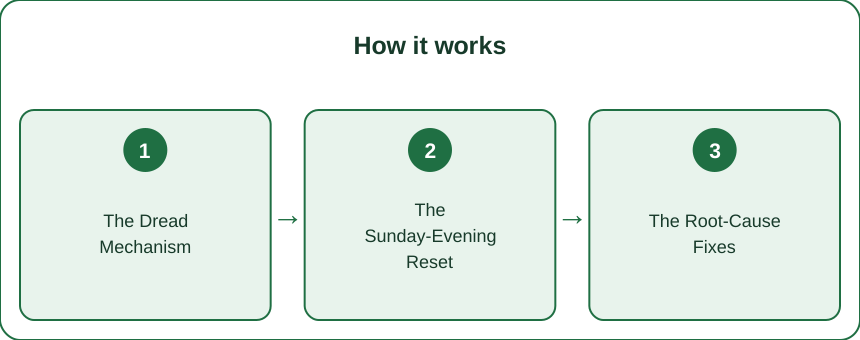
In-the-moment fixes help, but if the Scaries show up like clockwork, it’s worth addressing the structure of your week, not just Sunday night.
- Do your prep on Friday, not Sunday. Setting up next week before the weekend starts means Sunday isn’t carrying that looming-prep weight at all. It’s a small gift to your future self.
- Engineer a gentler Monday. No back-to-back meetings first thing, a little buffer time, one small thing to look forward to. A kinder on-ramp changes how the whole week feels before it even starts.
- Run a week-satisfaction audit. If the dread keeps coming back no matter what you try, ask honestly: is it the job, the workload, or a boundary you haven’t set? Persistent Sunday dread is often diagnostic, not random.
- Give yourself something to anticipate. A Monday coffee treat, a lunch plan, a class after work — anything that gives your brain a forward pull instead of a dread spiral.
Myth vs Fact
Myth: The Sunday Scaries mean you hate your job. Fact: Not necessarily. Plenty of people who genuinely like their work still get hit with anticipatory anxiety — it’s a nervous-system pattern, not a career verdict. It only becomes a real signal when it’s severe and constant.
Myth: Powering through Sunday emails will make Monday easier. Fact: It usually backfires. Checking work “just to get ahead” tends to restart the anxiety loop rather than calm it, and it eats into the rest that actually helps you handle Monday better.
Myth: You just need to relax more. Fact: Passive relaxing (scrolling, zoning out) rarely touches anticipatory anxiety, because the brain is still running its Monday forecast in the background. Active steps — the prep list, the worry dump — work better because they give your brain an actual answer instead of a vague “it’ll be fine.”
FAQ
Is the Sunday Scaries a real, recognized thing?
Yes — it’s a widely recognized pattern of anticipatory anxiety tied to the end of the weekend, not an official medical diagnosis on its own. It’s extremely common, so if you get hit with that dread, you’re in very good company.
How long does Sunday night dread usually last?
For most people it’s a few hours in the late afternoon or evening, easing once Monday actually starts and the “unknown” becomes known. If it lingers into Monday and beyond, or shows up every day of the week, that’s worth paying closer attention to.
When should I talk to a professional about it?
If the dread feels severe, physical, tips into depression-like symptoms, or doesn’t ease once Monday’s underway, that’s a good reason to loop in a therapist or doctor. This article covers general wellness habits, not a substitute for professional care — trust your gut if something feels heavier than “just Sundays.”
TL;DR:
- The Sunday Scaries are anticipatory anxiety — your brain forecasting stress before it happens.
- A 10-minute Monday prep, a protected wind-down evening, and a worry dump can defuse the dread in the moment.
- Moving your prep to Friday and engineering a gentler Monday shrink the dread at the root.
- If it’s intense and constant every week, treat it as a signal about your job or workload, not just a mood.
- Severe, persistent dread is worth a real conversation with a professional — this is general info, not medical advice.
Keep Reading
This article is for general informational purposes only and is not medical advice. Always consult a qualified health professional for guidance specific to you.