Why Your Summer Holiday Wore Off in Nine Days
Quick Answer: Research on the vacation effect consistently finds that improvements in wellbeing after a holiday fade quickly - often within a few weeks and sometimes within days of returning. The fade rate is determined mainly by workload on return, whether recovery happens during ordinary weeks, and job control. A longer holiday does not produce a longer-lasting effect.
If you came back in August feeling genuinely rested and by the second week of September feel exactly as you did before, that is the documented pattern rather than a personal failure.

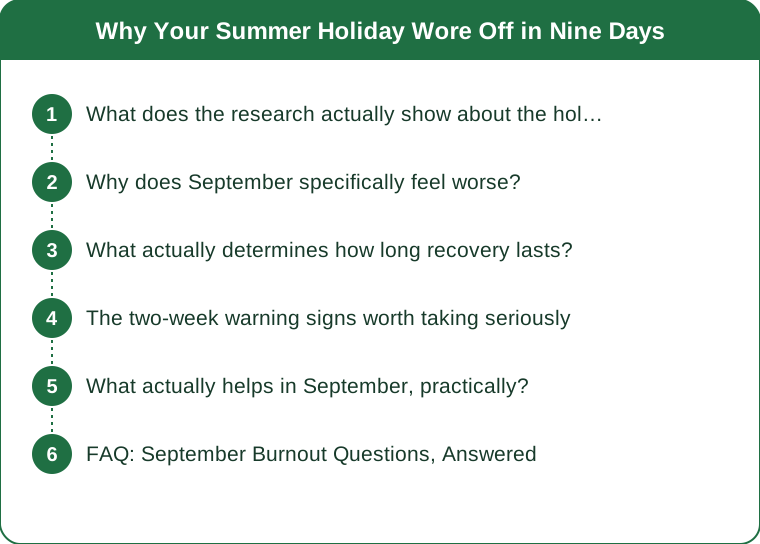
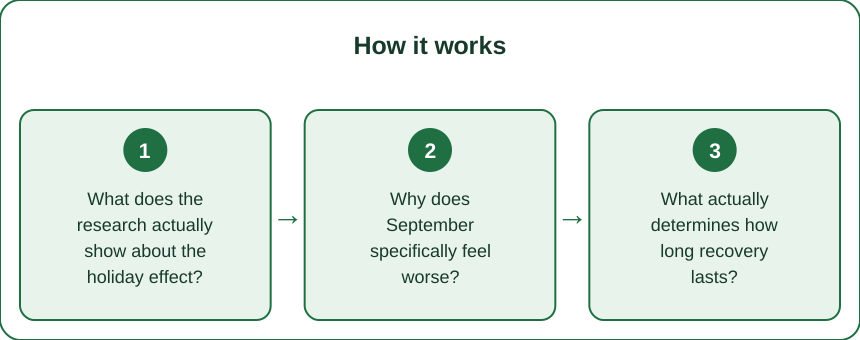
What does the research actually show about the holiday effect?
It is one of the more consistent findings in occupational health research, and it is not encouraging.
Wellbeing improves during a holiday. This is reliable - health and wellbeing measures rise during time off, with the improvement typically appearing within the first days.
The improvement fades quickly on return. Studies tracking employees after holidays generally find that gains dissipate within a few weeks, and in some cases within the first week back.
Longer holidays do not produce proportionally longer benefits. This is the most counterintuitive finding and the most useful. The relationship between holiday length and how long the effect lasts is weak - a two-week break does not protect you for twice as long as a one-week break.
What the effect is actually doing: a holiday relieves accumulated strain. It does not change the conditions that produced the strain, which resume the moment you return.
Why the fade can be so fast: the workload that accumulated during the absence has to be absorbed on return, often on top of the normal workload. The first week back is frequently more demanding than a normal week, which can erase the recovery immediately.
What this means: the useful question is not how to make holidays last longer. It is what happens in ordinary weeks, because that is where the actual determinant sits.
Why does September specifically feel worse?
Several factors converge, and they are not all psychological.
Everything restarts at once. Work projects deferred over summer, school terms, and social calendars all resume within about three weeks. The load increase is genuinely steep, not just felt as steep.
The contrast effect is strong. Coming from a period of low demand into a period of high demand makes the high demand feel higher than it would after a gradual increase.
Daylight reduces. Later sunrises and earlier sunsets affect circadian rhythm and, for many people, mood and energy. This is a real physiological input rather than an attitude.
There is nothing ahead. In June, the summer break is visible. In September, the next substantial break is months away, and that absence of a visible endpoint changes how the same workload feels.
Recovery opportunities shrink. Summer evenings support outdoor activity and social contact easily. September evenings do not, and the informal recovery that happened without planning has to be deliberately arranged instead.
The compound effect: higher demand, lower daylight, less spontaneous recovery, and no visible endpoint. Any one is manageable. All four arriving in the same three weeks is what produces the September pattern.
Worth naming clearly: this is a predictable seasonal load increase, not evidence that you cannot cope with your job.
What actually determines how long recovery lasts?
Research on recovery points to several factors that matter more than holiday length.
Workload on return. The strongest single factor. Returning to an accumulated backlog on top of normal work erases the recovery immediately.
What helps: a deliberately protected first day back with no meetings, an out-of-office that extends a day past your actual return, and returning midweek rather than on a Monday so the first week is shorter.
Job control. Having influence over how and when you do your work is consistently associated with better recovery and lower strain. Low control with high demand is the combination most strongly linked to burnout.
Psychological detachment during ordinary time off. The ability to mentally disengage from work in the evening and at weekends appears to be one of the more important recovery mechanisms - and it is one that checking messages after hours directly undermines.
Sleep. Underlies everything else, and is the first thing that erodes when demand rises.
Recovery during the week, not just at weekends. Small daily recovery appears to matter considerably. Something genuinely restorative on a weekday evening - not scrolling, which does not produce detachment - contributes more than a single large weekend effort.
The unwelcome conclusion: if your ordinary weeks provide no recovery, no holiday will fix it. The holiday relieves accumulated strain and the strain accumulates again at the same rate. That is a structural issue rather than a personal one.

The two-week warning signs worth taking seriously
Burnout is a process rather than an event, and it has recognisable stages before the point where it becomes difficult to reverse.
Early signals, roughly in the order they appear:
- Sunday evening dread that starts earlier each week - moving from Sunday night to Sunday afternoon to Saturday is a meaningful progression
- Cynicism about work you used to care about - this is one of the recognised dimensions of burnout and it often appears before exhaustion does
- Recovery not happening at weekends - waking Monday feeling as tired as Friday
- Withdrawal from things you enjoy - cancelling plans not from busyness but from not having the capacity
- Reduced sense of accomplishment - the same output feeling like it does not count
Physical signals: disrupted sleep despite being tired, more frequent minor illness, tension headaches, and appetite changes in either direction.
What distinguishes burnout from ordinary tiredness: ordinary tiredness resolves with rest. Burnout does not - a weekend off produces no meaningful improvement, and that lack of response to rest is the most useful distinguishing feature.
What distinguishes it from depression: there is overlap and they can co-occur. Burnout is typically work-context specific, while depression generally affects all areas of life. This distinction matters clinically and is not one to make yourself.
When to seek help: if rest is not producing recovery, if symptoms have persisted for weeks, or if you are experiencing persistent low mood, hopelessness, or thoughts of harming yourself. Speak to a doctor. This is general information, not medical advice, and burnout that has progressed is not something to manage alone.
What actually helps in September, practically?
Given that the structural factors matter most, the useful interventions are the ones that change ordinary weeks.
Protect one weekday evening completely. Not for errands or admin. For something restorative, ideally involving other people or physical activity, ideally not at home. One evening reliably protected does more than an intended three that get eaten.
Establish detachment boundaries and make them visible. Notifications off after a set time, work apps off the phone if possible. The evidence for psychological detachment is one of the more robust findings in recovery research, and the main obstacle to it is the device in your pocket.
Get outside in the morning. Ten minutes of outdoor light early supports circadian rhythm, mood, and sleep. As mornings get darker this becomes more valuable and harder, which is why it needs to be deliberate.
Front-load the diary in September, then stop. The month fills fast. Deciding early how many evening commitments you will take, and declining beyond that, is considerably easier than extracting yourself later.
Book something in October or November. The absence of a visible endpoint is part of what makes September heavy. A weekend away, or anything to look forward to, changes how the intervening weeks feel.
Have the workload conversation if the workload is the problem. Individual coping strategies do not fix a structurally unmanageable load, and framing an organisational problem as a personal resilience issue is how people end up burnt out while doing everything right.
If none of this is touching it, that is important information rather than a failure of effort. Speak to a doctor. This is general information, not medical advice.
FAQ: September Burnout Questions, Answered
Is it normal for a holiday to wear off this fast?
Yes. Research consistently finds the wellbeing benefits of holidays fade within weeks and sometimes days. It is the documented pattern, not a personal failing.
Would a longer holiday help?
Evidence suggests the relationship between holiday length and how long benefits last is weak. More frequent shorter breaks may be more useful than one long one.
How do I tell burnout from just being tired?
Ordinary tiredness responds to rest. Burnout does not - a weekend off produces little improvement. That lack of response is the most useful distinction.
Is burnout a medical diagnosis?
It is characterised as an occupational phenomenon rather than a medical condition in the international classification, though it can co-occur with conditions that are. If symptoms are persistent, a doctor is the right person to see.
What if the problem is genuinely the job?
Then individual strategies will only partially help. That is worth recognising rather than working around indefinitely, and it is a legitimate conclusion rather than a failure of coping.
TL;DR:
- The vacation effect fading within weeks is the documented pattern, and longer holidays do not last proportionally longer
- Workload on return is the strongest determinant - a protected first day back matters more than an extra holiday week
- September stacks four things at once: higher demand, less daylight, less spontaneous recovery, no visible endpoint
- Recovery during ordinary weeks matters more than any single break; psychological detachment is the key mechanism
- Tiredness that does not respond to rest is the signal that distinguishes burnout from ordinary fatigue
If rest is not producing recovery and it has been going on for weeks, speak to a doctor. This is general information, not medical advice.
Keep Reading
This article is for general informational purposes only and is not medical advice. Always consult a qualified health professional for guidance specific to you.