Micro-Recovery: 90-Second Resets for Days You Can't Escape
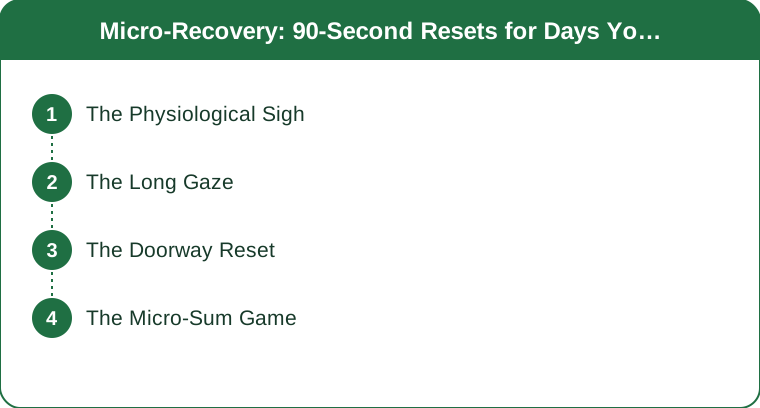
Quick Answer: Four 90-second resets you can do without leaving your desk: the physiological sigh (two quick nose inhales, one long exhale, three rounds), the long gaze (90 seconds looking at the farthest thing out a window), the doorway stretch between meetings, and a slow exhale at every transition. Six of these a day totals nine minutes and measurably reduces end-of-day depletion.
Most recovery advice assumes you have somewhere to go. Take a weekend. Book a spa day. Go on holiday.
Burnout, unhelpfully, does not wait for your PTO to be approved. It accumulates on a Tuesday afternoon between a status call and a deadline, which is exactly where the intervention needs to happen.

What’s the Fastest Way to Calm Your Nervous System?
The physiological sigh, and it takes about 20 seconds.
Two quick inhales through the nose — a full one, then a short second sip on top of it — followed by one long, slow exhale through the mouth. Repeat three times. That’s the whole technique.
The double inhale reinflates collapsed air sacs in the lungs, and the extended exhale activates the parasympathetic response that slows heart rate. It’s the pattern your body already does spontaneously when you’re crying or after a fright — the research (notably from Stanford’s Huberman lab) simply found that doing it deliberately produces the same downshift on demand.
Three rounds takes ninety seconds. It works mid-meeting with your camera off, in a lift, or in the two minutes before a call you’re dreading. It’s the single most reliable tool on this list because it requires no space, no equipment, and no one noticing.
Why Does Looking Out a Window Help?
Because screens hold your eyes at a fixed near distance for hours, and that fixation has a mental correlate.
Focusing at arm’s length engages the ciliary muscles continuously and narrows your visual field to a rectangle. Your visual system reads that sustained narrow focus as a state of alertness and effort — the same posture your eyes adopt when tracking something important at close range.
Ninety seconds of looking at the farthest thing you can see — a building on the horizon, a distant tree, clouds — releases the focus lock. Your eye muscles relax, your visual field widens, and the mental narrowing that was riding along with it tends to loosen too.
This is also the closest thing to a genuine remedy for screen-related eye fatigue that exists. The commonly cited 20-20-20 guideline (every 20 minutes, look 20 feet away for 20 seconds) is the same idea in smaller doses.
Clouds count as productivity now. You’re welcome.

What’s the Doorway Reset?
A transition ritual for the space between meetings, which is the part of the day that quietly does the most damage.
Stand in a doorway. Put a hand on each side of the frame at roughly shoulder height. Step forward slightly to open the chest, take one deep breath, and let your shoulders drop from wherever they’ve migrated to — usually somewhere near your ears.
Ten seconds of physical action, twenty of breathing. Under a minute total.
The point isn’t the stretch, though the chest opening genuinely counteracts hours of hunching forward. The point is the transition marker. Without one, meetings bleed into each other like wet ink and you carry the tension from a difficult 10am into an unrelated 11am. A physical ritual between them tells your nervous system that one thing ended before the next began.
If there’s no doorway available, the desk version works: hands behind your head, elbows wide, lean back over the chair, one deep breath.
5 Mistakes Everyone Makes With Micro-Breaks
1. Scrolling instead of resting. Checking your phone during a break gives your nervous system more input, not less. It feels like a break and functions like more work.
2. Waiting until you’re desperate. Micro-recovery works preventively. Deployed at 4pm when you’re already fried, it takes the edge off; deployed six times through the day, it stops you getting there.
3. Making it a project. If your reset requires an app, a timer, a cushion, and a quiet room, you won’t do it on the day you most need it. The best version is the one that survives a bad Tuesday.
4. Doing one long break instead of six short ones. Twenty minutes at lunch is good and doesn’t replace this. Nervous system regulation responds to frequency more than duration — small valves released often beat one big release.
5. Expecting it to fix an unsustainable job. This is the important one. Micro-recovery makes a demanding job survivable. It does not make an impossible one sustainable, and using it to endure conditions that need to change is a slow-motion problem.
Does Doing This Six Times a Day Actually Add Up?
Six resets a day is nine minutes — less than one scroll session, less than the time spent finding a parking space.
The reason it works out of proportion to the time invested is that stress isn’t a quantity you drain at the end of the day. It’s a level that rises through it. A nervous system held at high arousal for eight uninterrupted hours ends the day genuinely depleted; the same system brought down six times ends it noticeably less so, even though total “rest time” barely differs.
Recovery is not an event you schedule. It’s a valve you keep releasing.
A useful anchor: attach each reset to something that already happens. One physiological sigh before every meeting. One long gaze after every long email. One doorway stretch between calls. Tying it to an existing trigger is what turns it from a good intention into something you actually do.
Small comfort note: physical friction makes any of this harder to sustain. If you work from home, being in clothes you’re not fighting — a soft knit, a decent pair of high waist leggings — removes one more reason to skip the stretch.
When Is This Not Enough?
Honest caveat: micro-recovery is a coping tool, not a treatment.
If you’re experiencing persistent exhaustion that sleep doesn’t fix, cynicism or detachment about work you used to care about, a sense of reduced competence, or physical symptoms like ongoing headaches, disrupted sleep, or changes in appetite — those are the recognized markers of burnout as a syndrome, and ninety-second breaks won’t resolve them.
Talk to a doctor or a mental health professional if that’s where you are, particularly if you’re also experiencing low mood, hopelessness, or difficulty functioning outside work. Burnout that’s reached that stage typically needs a change in conditions, professional support, or both — and getting help early makes the recovery considerably shorter.
Frequently Asked Questions
How often should I actually take a micro-break?
Roughly once an hour is a good target, which lands you at six to eight a day. If that feels like a lot, start with three — one mid-morning, one after lunch, one mid-afternoon — and anchor each to something already in your calendar so you don’t have to remember.
Does the physiological sigh work if I’m already panicking?
Often yes, and it’s one of the better tools for acute stress because the long exhale directly slows heart rate. It’s less effective mid-panic-attack than used preventively, though. If you experience panic attacks regularly, this is worth raising with a doctor rather than managing alone with breathing techniques.
Can I do these during video calls without it being obvious?
The physiological sigh, yes — camera off, or even camera on if you keep the exhale quiet. The long gaze is easy to disguise as thinking. The doorway stretch obviously isn’t, but its desk version (hands behind head, lean back, breathe) reads as ordinary stretching and nobody comments on it.
TL;DR:
- Physiological sigh: two nose inhales, one long exhale, three rounds. Fastest downshift available
- Long gaze: 90 seconds looking at the farthest thing out a window. Releases focus lock
- Doorway reset: stretch the frame, one breath, drop the shoulders. Marks the transition between meetings
- Six a day = nine minutes total, and the cumulative effect on depletion is real
- Don’t scroll during a break — it’s more input, not less
- Anchor each reset to something already in your day so you actually do it
- This makes a demanding job survivable; it doesn’t fix an unsustainable one. See a professional if the exhaustion persists
Your nervous system takes payments in small installments. The spa day can stay hypothetical.
Keep Reading
This article is for general informational purposes only and is not medical advice. Always consult a qualified health professional for guidance specific to you.