How to Actually Have the Burnout Conversation With Your Manager
Quick Answer: Prepare three things before the conversation: a factual description of what has changed in your work, two or three specific requests, and what you can still deliver. Frame it around workload and sustainability rather than around feelings, ask for a scheduled meeting rather than raising it in passing, and put the agreed outcome in writing afterwards. Specific asks get acted on; general statements about being overwhelmed usually do not.
The conversation tends to happen in one of two ways. Either it never happens - you carry it for six months and then resign - or it happens at the worst possible moment, unprepared, in a one-to-one that was meant to be about a project. Neither produces a change. There is a third version that does, and it mostly comes down to preparation.

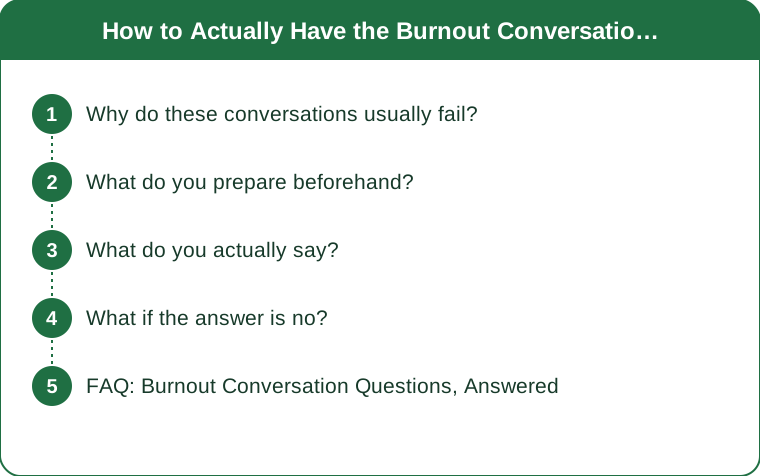
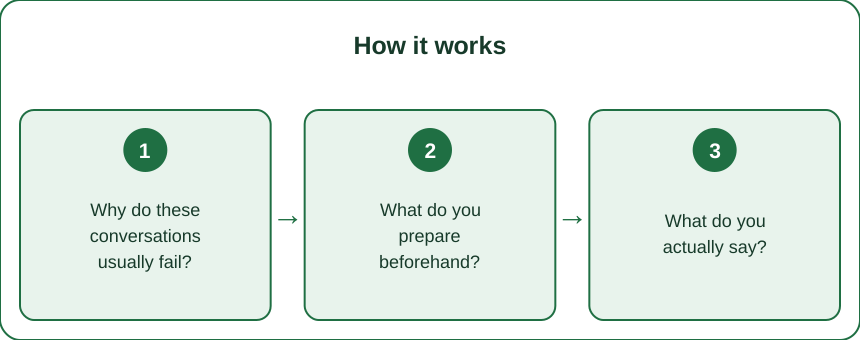
Why do these conversations usually fail?
Three predictable reasons, and each one is fixable in advance.
The ask is not specific. Saying you are overwhelmed describes a state. A manager hearing it may sympathise, and then has nothing actionable. Saying you need the Q4 reporting moved off your plate for six weeks is something a person can act on this afternoon.
The timing is wrong. Raised at the end of a packed meeting, or in the middle of a crisis, it gets acknowledged and then lost. Burnout conversations need their own slot with a clear purpose.
It comes out as either an apology or an accusation. Both are understandable and both make the conversation harder. Apologising invites reassurance rather than action. Accusing invites defensiveness. The register that works is factual and forward-looking: here is what has changed, here is what I need, here is what I can still do.
There is a fourth reason worth naming: some workplaces genuinely will not respond well. That is real, and it is information rather than a reason not to try. A conversation that goes badly tells you something important about whether the situation is fixable where you are.
What do you prepare beforehand?
Write these three things down. Not to read aloud - to have thought them through.
1. What has changed, factually. Not how you feel, but what is observable:
- The workload changes - two people left and their work was absorbed, the project scope doubled, the number of meetings went from six to eighteen a week
- The effects on work - deadlines slipping, more errors, longer to do things that used to be quick
- How long it has been going on
2. Two or three specific asks. These are the whole conversation. Good ones:
- Deprioritise or hand over a named piece of work
- A deadline moved by a specific amount
- No meetings before 10am, or a protected focus block
- A week of leave, starting on a specific date
- Additional resource on a named project
- A temporary reduction in hours
3. What you can still commit to. This is the part people skip and it matters enormously. It reframes the conversation from I cannot cope to here is how I stay effective, and it gives your manager something to work with rather than a problem to solve alone.
Ask for the meeting explicitly. A short message - I would like 30 minutes to talk about my workload and what is sustainable - sets the frame before you are in the room.

What do you actually say?
A structure that works, roughly four minutes:
Open with the purpose. I want to talk about my workload, because the current level is not sustainable and I would rather address it now than when something breaks.
Give the facts. Since March, I have taken on X and Y in addition to my own role. My meeting load has roughly doubled. I am working most evenings to keep up, and things are still slipping.
Name the effect on work, not just on you. The reporting has been late twice, and I am spending time correcting errors I would not normally make.
Make the asks. There are three things that would help. First… Second… Third…
Say what you can still do. I can absolutely keep delivering on A and B - those are the priorities and they are manageable. It is C and D that are the problem.
Then stop talking. Silence after an ask is uncomfortable and it is the point at which your manager actually has to respond. Filling it - which is the natural instinct - often undoes the request.
On disclosure: you decide how much personal detail to share. You do not owe a diagnosis or a description of your mental health to explain a workload problem. Some people find sharing more helps; others find it shifts the conversation from workload onto their resilience, which is not where you want it.
And write it up afterwards. A short email - thanks for the conversation, my understanding is we agreed X, Y and Z - is not aggressive, it is how things get remembered and actioned.
What if the answer is no?
Sometimes it will be, and having thought about this in advance stops the conversation from becoming a dead end.
Ask what is possible instead. If the whole request is refused, the follow-up question is: given that, what would you like me to deprioritise? That question is hard to avoid, and it moves the decision about what does not get done to the person who should be making it.
Get the trade-off in writing. If nothing can be removed and nothing can move, the record should show that you raised it. That matters both practically and, if things escalate later, formally.
Escalate if you need to. HR, a skip-level manager, or occupational health where it exists. Occupational health in particular is often underused and can recommend adjustments with more weight than you have alone.
Know the medical route exists. If you are struggling, a doctor is a legitimate first stop - both for support and because a formal note carries obligations that a conversation does not. Burnout affects sleep, concentration, and physical health, and it is worth being assessed rather than absorbed.
And treat a flat no as data. A workplace that cannot adjust anything, ever, in response to a clearly presented and reasonable request is telling you something about the next two years. That is worth knowing before you spend them there.
This is general information, not medical or legal advice. If you are struggling with your mental health, speak to a doctor.
FAQ: Burnout Conversation Questions, Answered
Should I tell my manager I am burnt out?
Usually yes, framed around workload and sustainability rather than as a diagnosis. Specific, actionable requests get responses; general statements about feeling overwhelmed often do not.
What if my manager is the cause of the problem?
The same preparation applies, and the escalation route matters more. Bring facts and specific asks, put the outcome in writing, and involve HR or a skip-level manager if nothing changes.
Do I have to explain why?
No. You can describe the workload and what you need without disclosing personal or medical details. How much you share is your decision, and more is not always better.
TL;DR:
- Prepare three things: what has factually changed, two or three specific asks, and what you can still deliver.
- Request a dedicated meeting rather than raising it in passing.
- Make the ask, then stop talking - the silence is where the response happens.
- If the answer is no, ask what to deprioritise, get it in writing, and treat the refusal as information.
The conversation is not a confession and it is not a complaint. It is a workload discussion with a clear request attached, and prepared that way it is far more likely to change something than to cost you anything.
Keep Reading
This article is for general informational purposes only and is not medical advice. Always consult a qualified health professional for guidance specific to you.