What to Actually Do About Burnout When Quitting Your Job Isn't an Option Right Now
Quick Answer: When leaving the job causing burnout isn’t currently possible, the realistic focus shifts to controlling what’s actually controllable within the role — boundaries around hours, recovery time outside work, and specific role changes where possible — rather than the common but often inaccessible advice to simply quit or take extended leave.
Every burnout article you’ve read leads to the same advice: quit, take a sabbatical, find a new job. For a lot of very real reasons — financial, visa status, being the sole earner, career stage — that advice just isn’t available to you right now. There’s still a real path forward.

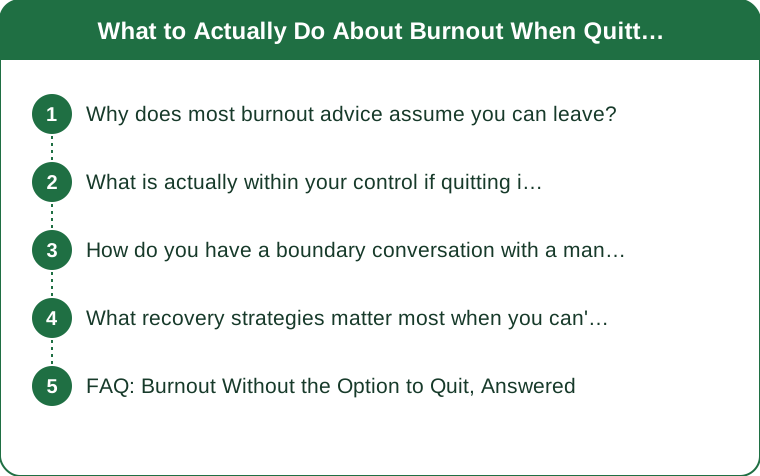
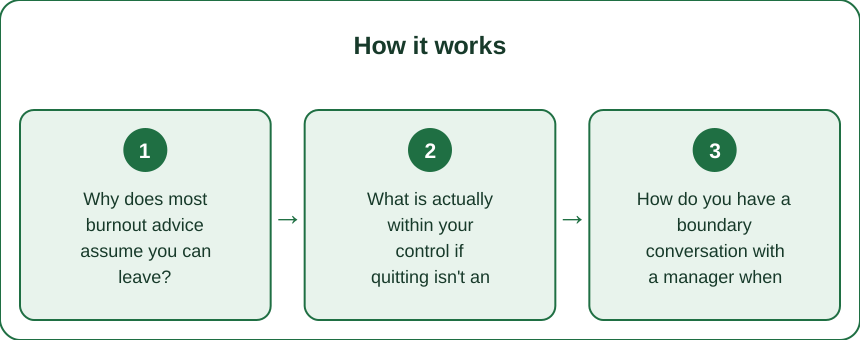
Why does most burnout advice assume you can leave?
Because leaving the stressor is the most straightforward intervention, and it’s genuinely effective when accessible. But a large portion of people dealing with burnout don’t have that option in the near term, and generic advice that ignores this reality tends to leave people feeling more stuck, not less.
What is actually within your control if quitting isn’t an option?
Focus shifts to the controllable margins around the job rather than the job itself: protecting non-negotiable boundaries around start/end times where possible, defending recovery time outside work hours, and identifying specific tasks or responsibilities that might be negotiable even if the role overall isn’t.

How do you have a boundary conversation with a manager when you can’t leave?
Framing requests around sustainability and output (‘I want to keep delivering at this level long-term, which means I need X’) tends to land better than framing them purely around personal wellbeing, which some managers respond to less consistently. This isn’t about hiding the real reason — it’s about connecting the request to something the workplace already values.
What recovery strategies matter most when you can’t reduce the source?
Protecting non-work hours becomes disproportionately important when work hours themselves can’t change — genuinely disconnecting after hours (not just physically leaving but mentally as well) does more to counter burnout than most people expect, even without changing the job itself.
This is also where a mental health professional can add real, specific value — burnout that can’t be solved by removing the stressor often benefits from a structured coping strategy tailored to your specific situation, rather than generic advice.
FAQ: Burnout Without the Option to Quit, Answered
Is it possible to fully recover from burnout while still in the job causing it?
Full recovery is harder without addressing the root cause, but meaningful symptom improvement is possible through boundary-setting and recovery strategies, even if it’s not a complete fix.
Should I be honest with my manager that I’m burned out?
This depends heavily on your specific workplace culture and relationship with your manager — framing around sustainability, as above, is often a safer starting point than an open-ended disclosure.
How do I know if it’s time to reconsider quitting despite the constraints?
If burnout symptoms are affecting physical health, relationships, or safety, that’s worth weighing seriously against the constraints keeping you in the role, ideally with input from a professional.
TL;DR:
- Most burnout advice assumes you can leave the job — that’s not accessible for everyone
- Focus on controllable margins: boundaries, recovery time, and negotiable parts of the role
- Frame boundary requests around sustainability and output, not just personal wellbeing
- Protecting non-work hours matters more when the job itself can’t change
This is general information, not medical advice — persistent burnout affecting your health is worth discussing with a mental health professional.
Keep Reading
This article is for general informational purposes only and is not medical advice. Always consult a qualified health professional for guidance specific to you.