You Changed Jobs and the Burnout Came With You
Quick Answer: Burnout that persists after a job change usually means one of three things - you never recovered from the first episode, the same conditions exist in the new role, or the patterns you brought with you recreated them. Physiological recovery from sustained burnout typically takes months, not the two weeks between jobs, and starting a demanding new role while still depleted is the most common version of this.
The new job was supposed to be the fix. It has been three months and the Sunday evening dread is back, and that is a genuinely disorienting thing to notice.

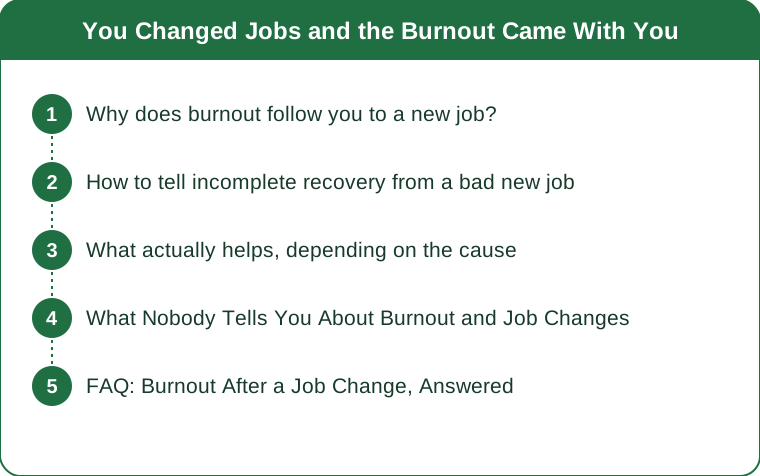
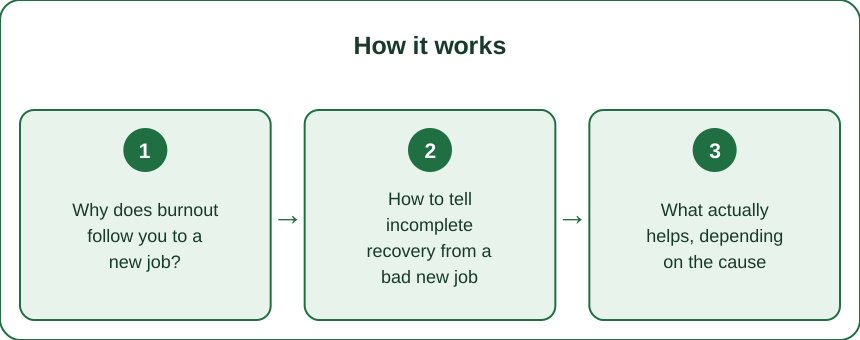
Why does burnout follow you to a new job?
Three explanations, and for most people it is a combination rather than one.
1. You never actually recovered. This is the most common and the most overlooked. Recovery from sustained burnout is not measured in weeks. Research on burnout recovery consistently describes timelines of months, and often a year or more for severe cases, with the return of energy lagging well behind the return of function.
Most job changes involve a two-week gap at most, and much of that goes on admin and anxiety about starting. Then you begin a new role - which demands more energy than a familiar one, not less. Learning systems, meeting people, proving yourself, no established competence to coast on. A new job is one of the most demanding things you can do while depleted, and the honeymoon energy of the first weeks masks it until it runs out at around month three.
2. The conditions are the same. Burnout is driven by workplace conditions - workload, control, reward, community, fairness, and values alignment. If the new job has the same structural problems, you will get the same result. Industries share norms, and moving within one often means moving between organisations with near-identical expectations about hours, availability, and pace.
3. The patterns came with you. Overcommitting, never saying no, checking messages at night, taking on other people’s problems, tying self-worth to output. These are habits, and habits travel. In a new job there is added pressure to prove yourself, which makes them worse rather than better.
Which one is it? Ask what changed and what did not. If the workload is genuinely lighter and the culture better, and you still feel this way, it is likely incomplete recovery. If your hours and habits look the same as before, it is one of the other two.
How to tell incomplete recovery from a bad new job
The distinction matters, because the responses are entirely different.
Signs it is incomplete recovery:
- The exhaustion was there from day one, or returned very quickly - within weeks rather than months
- You feel tired in ways unrelated to work - weekends, holidays, mornings after long sleep
- Cynicism and detachment appeared before you had enough experience of the new place to have earned them
- Objectively better conditions do not feel better. Fewer hours, nicer people, and the same flatness.
- Physical symptoms persist - poor sleep, frequent illness, headaches, digestive problems
- You cannot enjoy things outside work either, which points to depletion rather than a job problem
Signs the new job is genuinely the problem:
- You felt noticeably better during the gap between jobs, even briefly
- The first weeks were genuinely good and it deteriorated as you learned what the role actually involved
- You can name specific conditions - the workload, a particular manager, the on-call rota, the pace
- Colleagues describe the same experience. This is the strongest single signal that it is environmental.
- You feel fine on holiday and dread returning, specifically
Signs it is patterns you brought:
- Your hours crept back up without anyone asking
- You volunteered for things you did not have capacity for
- You still check messages outside work hours by choice
- You have not said no once since starting
A caution worth taking seriously: burnout and depression share considerable overlap - exhaustion, low mood, loss of interest, sleep and appetite changes. Depression does not lift when work does. If you feel this way regardless of the day of the week, if you have lost interest in things you used to enjoy outside work, or if you have thoughts of harming yourself, that is a reason to see a doctor now rather than reading further.

What actually helps, depending on the cause
If it is incomplete recovery:
- Accept the timeline. Months, not weeks. Fighting it produces more depletion, and the single most useful thing is often to stop expecting to be back to normal.
- Protect sleep above everything else. It is the foundation of recovery and the first thing sacrificed.
- Reduce discretionary load outside work. Social commitments, side projects, obligations. You have less capacity than you had, and spending it as though you do not is why recovery stalls.
- Gentle regular movement, not intensive training. Walking is genuinely useful here.
- Lower your performance expectations in the new job for the first six months. Being adequate is enough. Trying to prove yourself while depleted is how the second episode starts.
- Consider whether you need actual time off. A period of proper rest, with medical support if appropriate, sometimes is the only thing that works - and it is more available than people assume.
If it is the new environment:
- Name the specific conditions rather than concluding the job is bad. Workload, control, and unfairness need different responses.
- Test whether they are changeable. A conversation with your manager about workload or scope tells you a great deal, and the answer determines everything after it.
- Do not immediately job hunt again. Two moves in a year, both while depleted, is a pattern that compounds rather than resolves.
If it is patterns you brought:
- Start saying no now, in the first year, while expectations are still forming. It is far easier to establish a boundary than to reset one.
- Pick one boundary and hold it absolutely - no messages after 7pm, or a real lunch break away from the desk. One held boundary beats five intended ones.
- Notice the volunteering impulse and wait 24 hours before agreeing to anything additional
- Address the underlying belief if you can. Tying worth to output is the engine underneath most of this, and it usually needs more than a scheduling change - therapy is genuinely effective for it.
What Nobody Tells You About Burnout and Job Changes
Month three is when it typically surfaces. The novelty energy of a new role carries most people through the first eight to twelve weeks. When it runs out, whatever was underneath becomes visible - which is why so many people describe this happening at almost exactly the same point.
Changing jobs is itself a major stressor, even when the new job is better. New environment, new relationships, new competence to build, often a new commute or city. You spent significant energy on the change itself, and that comes out of the same account.
Recovery is not linear and the dips are not relapses. Good weeks followed by bad ones is the normal shape. People frequently interpret a bad week as proof that nothing is working and abandon the changes that were helping.
The gap between jobs is almost never a recovery period. It is usually spent on notice periods, handovers, admin, and anxiety about starting. If you have the option of a real break between roles, it is worth more than a higher starting salary - and almost nobody takes it.
Burnout has physiological components and does not resolve through willpower or attitude. Sleep architecture, stress hormone patterns, and immune function are affected, and they recover on their own timeline. Treating it as a mindset problem is why people push through and end up worse.
Sometimes the honest answer is that the field is the problem. Some sectors have structural conditions - chronic understaffing, unmanageable caseloads, a culture of unpaid hours - that no individual employer within them escapes. Moving within the sector produces the same result, repeatedly, and that is worth recognising sooner rather than after the third move.
Telling someone at the new job is a real option. Not everyone can, and where there is a decent manager or occupational health service, saying you are managing your workload carefully after a difficult period is often met better than expected. Hiding it costs energy you do not have.
Recovery frequently changes what you want. People who recover properly often report caring less about advancement and more about sustainability, and describe that as a gain rather than a loss.
FAQ: Burnout After a Job Change, Answered
How long does burnout recovery actually take?
Months for most people, and a year or more where it was severe or prolonged. The return of energy lags behind the return of function, which is why people think they are recovered before they are.
Should I quit again?
Not immediately, and not while still depleted. First work out which of the three causes applies. Quitting resolves an environmental problem and does nothing for incomplete recovery or imported patterns.
Is this burnout or depression?
They overlap substantially. Burnout is tied to work and typically eases when away from it; depression persists across contexts and affects things you used to enjoy. If the flatness follows you everywhere, see a doctor.
Can I recover while still working?
Many people do, particularly with reduced hours, adjusted scope, or a genuinely lighter role. Severe burnout sometimes requires time off, and that is a medical question rather than a willpower one.
Should I tell my new employer?
It depends on the workplace. Where there is a supportive manager or occupational health service, it is often received better than expected and opens up adjustments. This is general information, not medical advice - please speak to a doctor or mental health professional about your own situation.
TL;DR:
- Burnout that follows a job change usually means incomplete recovery, the same conditions, or imported patterns
- Recovery takes months, and a new job is one of the most demanding things to do while depleted
- Month three is when it typically surfaces, once the novelty energy runs out
- Diagnose which cause applies before acting - quitting fixes only one of the three
- If the flatness follows you outside work too, that is a conversation with a doctor
The most useful reframe here is that a new job is a demand, not a rest. If you never got a genuine recovery period, the fair conclusion is not that you chose wrong - it is that you have not had the thing you actually needed yet. This is general information, not medical advice.
Keep Reading
This article is for general informational purposes only and is not medical advice. Always consult a qualified health professional for guidance specific to you.