Burnout Recovery When Quitting Your Job Isn't an Option Right Now
Quick Answer: When quitting isn’t realistic, burnout recovery shifts toward smaller, sustainable levers — protecting specific boundaries, micro-recovery moments throughout the workday, and addressing the parts of the job that are actually changeable, rather than waiting for a full escape that may not come soon.
Most burnout content assumes a dramatic exit is available — quit, take a leave, negotiate a sabbatical. For a lot of people, none of those are realistic right now, and the advice built around them just adds guilt on top of exhaustion.

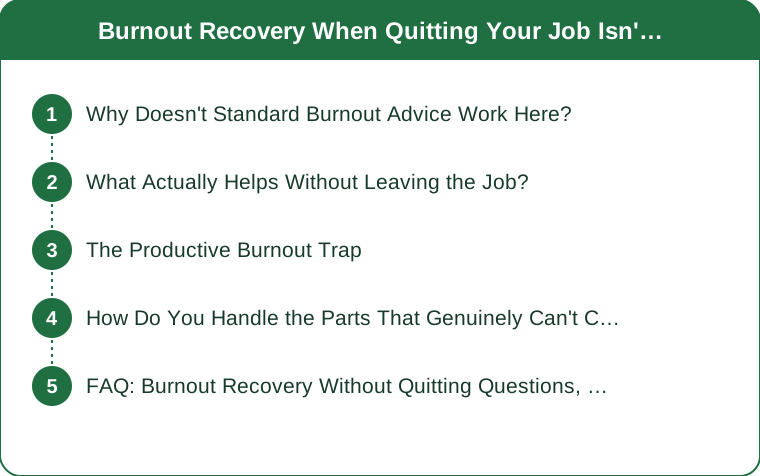
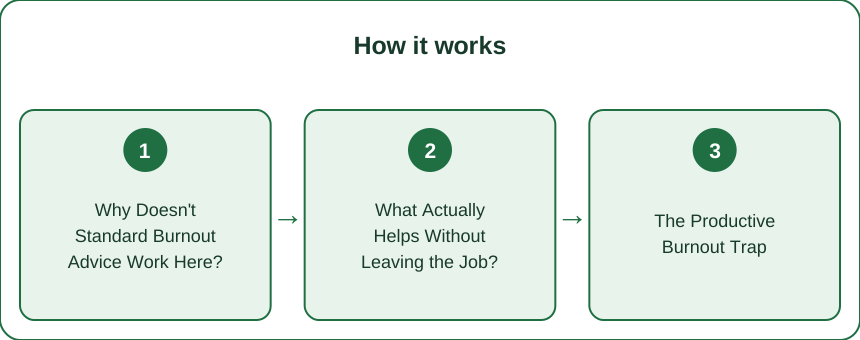
Why Doesn’t Standard Burnout Advice Work Here?
Advice centered on removing the stressor entirely — quitting, taking extended leave — assumes a level of financial or logistical flexibility that many people simply don’t have, whether due to being the primary earner, a visa tied to employment, or a job market that makes leaving genuinely risky right now.
This doesn’t mean recovery is impossible without quitting — it means the levers available are smaller and more specific, targeting what’s actually changeable within the job rather than the job itself.
What Actually Helps Without Leaving the Job?
Identifying and protecting one or two specific boundaries — not responding to messages after a set hour, declining non-essential meetings, or blocking uninterrupted focus time — tends to create more sustainable relief than a vague goal to “set better boundaries” generally.
Micro-recovery moments throughout the workday — a genuine 5-10 minute break away from the screen, a short walk between meetings — accumulate meaningfully over a week even though each one feels too small to matter individually.

The Productive Burnout Trap
A common trap: using any small energy improvement to immediately take on more work, rather than protecting that recovered capacity for actual rest. This “productive burnout” pattern means recovery efforts never accumulate, since each gain gets reabsorbed into more output almost immediately.
Breaking this requires a deliberate decision to bank some recovered energy as rest, not just redirected productivity — genuinely difficult in a culture that treats any slack as wasted potential, but necessary for burnout to actually improve rather than just shift.
How Do You Handle the Parts That Genuinely Can’t Change Right Now?
Separating what’s changeable from what isn’t, even roughly, reduces the mental load of constantly renegotiating the same unsolvable problems in your head. A workload that’s structurally too high might not be fixable by you alone this month — acknowledging that directly, rather than treating it as a personal failure to manage better, is itself a form of relief.
Where possible, having a direct, specific conversation with a manager about workload — framed around impact and priorities rather than burnout itself — sometimes creates more flexibility than assumed, even short of a full job change.
FAQ: Burnout Recovery Without Quitting Questions, Answered
Is it actually possible to recover from burnout without changing jobs?
Meaningful, if partial, recovery is possible through targeted boundaries and micro-recovery habits, though full resolution sometimes does require a bigger structural change eventually.
What’s the fastest thing to try this week if I can’t make any big changes?
Pick one specific boundary — like not checking messages after a set hour — and protect it consistently rather than trying to overhaul everything at once.
How do I stop immediately using any energy improvement to just take on more work?
Deliberately decide in advance what a recovered hour or day will be used for (rest, not more output) before the energy actually returns, so the decision isn’t made reactively in the moment.
TL;DR:
- Standard burnout advice often assumes an escape option that isn’t realistic for everyone
- Protecting one or two specific boundaries beats a vague goal to “set better boundaries”
- Micro-recovery moments accumulate over a week even though each feels small
- Watch for the trap of immediately reinvesting recovered energy into more work
This is general information, not a substitute for support from a therapist or counselor if burnout is severe — but small, specific, sustainable changes are a legitimate form of progress, even without a dramatic exit.
Keep Reading
This article is for general informational purposes only and is not medical advice. Always consult a qualified health professional for guidance specific to you.