Burnout Recovery When Your Manager Is Actually the Cause
Quick Answer: When a manager is the direct cause of burnout, personal recovery habits (sleep, boundaries, rest) still matter but won’t resolve the core issue — the realistic paths are documenting patterns, seeking role or team changes internally, or planning an exit, since the standard ‘self-care’ framing doesn’t fix a structural problem.
Most burnout advice assumes the job itself is just demanding. It gets a lot more complicated when the actual source is a specific person you report to every day.

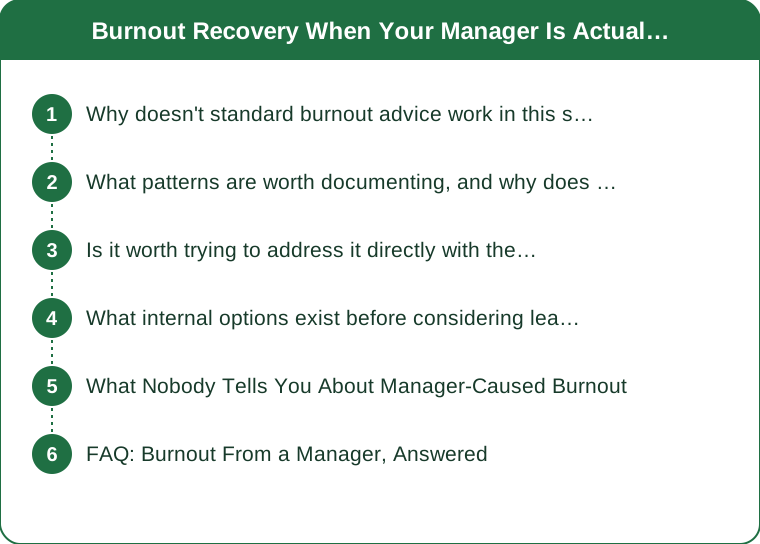
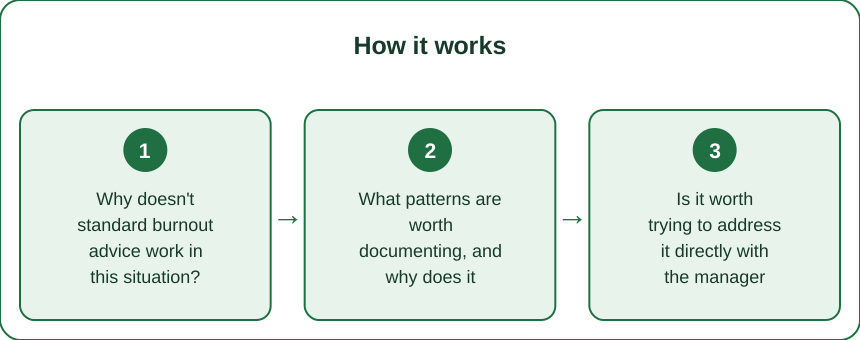
Why doesn’t standard burnout advice work in this situation?
Most mainstream burnout guidance focuses on individual recovery habits — sleep, boundaries, mindfulness — which genuinely help with the physical and emotional symptoms of burnout but don’t address a situation where the daily trigger is a manager’s behavior that repeats regardless of your personal habits. Applying only individual-level fixes to a structural, relationship-level problem tends to produce frustration when the exhaustion returns almost immediately after a good night’s sleep.
What patterns are worth documenting, and why does it matter?
Keeping a simple, factual log of specific incidents — dates, what was said, what happened — serves two purposes: it gives you concrete language for an HR conversation or exit interview if needed, and it helps you see whether the pattern is escalating, staying steady, or actually improving over time, which is hard to judge accurately from memory alone under chronic stress.
Is it worth trying to address it directly with the manager first?
In some cases, yes — a calm, specific conversation about workload or communication style can improve things if the manager is unaware of the impact rather than acting deliberately. But if previous attempts at direct conversation have gone nowhere or made things worse, it’s reasonable to skip straight to HR, a skip-level manager, or planning an exit rather than repeating an approach that hasn’t worked.

What internal options exist before considering leaving the company entirely?
A team transfer or role change within the same company solves the manager problem while preserving your tenure, benefits, and internal relationships, and is often underused because people assume the only options are ‘tough it out’ or ‘quit the company.’ Raising this possibility with HR or a skip-level manager, framed around growth rather than complaint, tends to land better than framing it purely as an escape.
What Nobody Tells You About Manager-Caused Burnout
The clearest sign this isn’t a ‘you need better boundaries’ problem is that exhaustion consistently returns almost immediately after time off, since rest resolves fatigue caused by workload but doesn’t resolve fatigue caused by an ongoing relationship stressor. If a vacation restores you for exactly as long as you’re away from that specific manager and then collapses the moment you’re back in contact, that’s a strong signal the source is relational, not just volume of work.
FAQ: Burnout From a Manager, Answered
Should I mention burnout specifically in an HR conversation?
Yes, using specific documented incidents alongside the word ‘burnout’ helps HR understand the severity rather than treating it as a vague complaint.
Is it worth staying just to avoid restarting my job search?
Weigh this carefully — chronic manager-caused burnout has real long-term health costs, and a job search, while effortful, is usually the shorter-term cost.
Can therapy help if the manager isn’t going to change?
Yes, therapy can help process the stress and support decision-making, but it’s a coping tool alongside — not a replacement for — addressing the structural cause directly.
TL;DR:
- Individual recovery habits help with symptoms but don’t fix a manager-caused structural problem
- Document specific incidents factually — it clarifies patterns and supports HR or exit conversations
- A direct conversation can help if unawareness is the issue, but don’t repeat what hasn’t worked
- Internal transfer is an underused option between ‘tough it out’ and quitting entirely
If rest only helps while you’re away from your manager and collapses the moment you’re back, that’s the clearest signal of where the real problem lives.
Keep Reading
This article is for general informational purposes only and is not medical advice. Always consult a qualified health professional for guidance specific to you.